
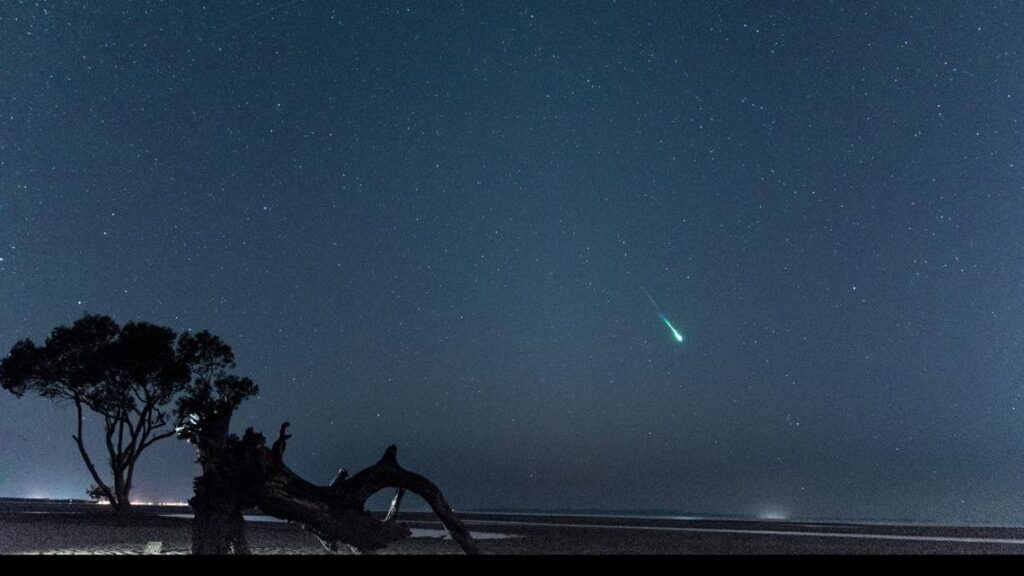
The Eta Aquarid meteor shower reaches its peak in early May each year and is notable for its fast-moving meteors.
The Eta Aquarid meteor shower peaks early May each year, with meteors known to be fast-moving that leave behind glowing trails.
The meteors travel fast at speeds of roughly 40.7 miles per second when entering the Earth’s atmosphere. They leave behind glowing “trains,” which NASA describes as “incandescent bits of debris in the wake of the meteor” that can last several seconds to minutes.
These meteors are commonly referred to as “shooting stars.”
During its peak, about 50 meteors can be seen per hour, but clear conditions and dark skies are a must for best viewing.
According to NASA, the meteors are derived from leftover comet particles and bits from broken asteroids.
When the Earth passes through these debris trails, the particles burn up in the atmosphere, creating bright streaks in the sky.
The comet that the Eta Aquarids originate from is 1P/Halley.
Halley’s Comet takes roughly 76 years to orbit the sun and is named after Edmund Halley, who discovered it in 1705, though historic references that seem to reference the comet date back centuries before the 18th century, according to NASA.
The last time Halley’s Comet passed through the inner solar system was in 1986 and won’t return until 2061.
When is the best chance to see the meteor shower?
The Eta Aquarids meteor shower is expected to peak between May 5 and May 6. However, the moon will be bright during this time, which scientists say is expected to “wash out” many of the meteors.
While it’s still worth trying to see the shooting stars during their peak, NASA recommends stargazers mark down May 18 as one of the best opportunities to catch the meteor shower this year, looking west just after the sun sets.
For the best chance to spot the meteors, the space agency recommends going somewhere dark to let your eyes adjust for about 20 to 30 minutes beforehand and avoid bright lights, including phone screens.