
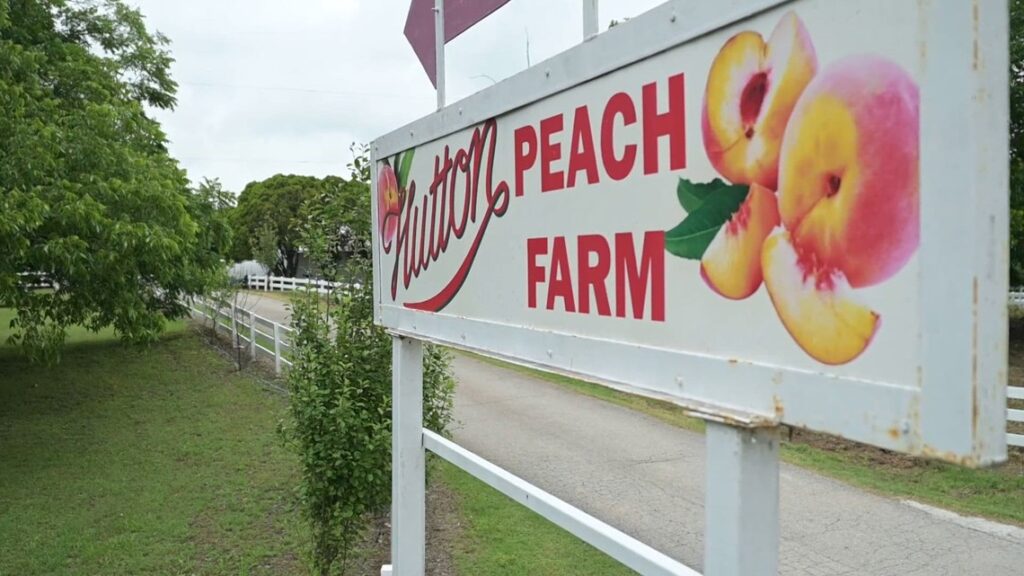
A shortage of chill hours and a March frost have cut into fruit yields across the state, though some orchards say they have enough to carry the season.
PARKER COUNTY, Texas — Gary Hutton did not choose the peach business so much as fall into it. His orchard in Weatherford spans 4,500 trees, and every spring he finds himself hoping nature cooperates.
“Somehow we make it come together every year,” said Hutton, a Parker County peach grower with Hutton Peach Farm.
This year, nature has been less cooperative than most. A mild winter delivered fewer chill hours than Texas orchards require, and a late freeze in March compounded the damage — a combination that fruit specialists say will reduce yields for peaches, apples, blueberries and blackberries across the state.
Tim Hartmann, a statewide fruit specialist and assistant professor at the Texas A&M AgriLife Extension Service, has been tracking chill hour reports from producers across Texas. He said the numbers this past winter fell well below average.
Chill hours — defined as the number of winter hours when temperatures hold below 45 degrees Fahrenheit — are essential for temperate fruit crops, including peaches, apples, blackberries and blueberries. The exposure triggers dormancy, allowing plants to survive winter and emerge ready to flower and set fruit.
“If you don’t get enough sleep, you’re likely to oversleep and will not function at your highest capacity,” said Hartmann. “In the same way, trees that don’t reach the required chill hours will bud late and not be productive.”
The required hours vary widely by variety.
Peaches grown in South Texas may need as few as 200 hours, while some varieties along the Red River require more than 1,000. Without adequate chilling, Hartmann said growers can expect delayed and uneven bud break, poor flower set, and abnormal fruit development.
“You have some buds growing, you have some not, you have fewer flowers…many of those flowers don’t even set,” Hartman said.
Beyond the chill hour deficit, unusually warm spells between cold periods, dry fall conditions, and foliage that persisted late into winter all degraded fruit crop potential, Hartmann said. Then came the March frost.
Blueberry producers in Southeast Texas absorbed a hard freeze in late January but have begun harvest with a modest crop intact. Growers farther north fared worse as some reported complete crop losses, particularly where no frost protection was in place, according to Hartmann.
Hutton acknowledges his harvest will not match a strong year. In good seasons, a single tree in his orchard can carry up to 5,000 peaches. This year, the count will be lower.
“That’s just the nature of the game,” said Hutton.
Still, he said he has enough fruit to open the market and carry the season. Some varieties will be available at opening; the remainder are expected in time for the Parker County Peach Festival in July.
Hartmann said producers have tools to fight back against adverse weather.
Overhead irrigation can generate enough heat through the continuous freezing of water to protect buds during frost events. Wind machines provide similar protection under calm, clear conditions. Some peach growers also apply hydrogen cyanamide, a chemical growth regulator that can partially replicate the effect of chill hours — though Hartmann cautioned it is not a universal fix, can be difficult to obtain and may cause trees to bloom earlier, raising frost risk.
The most reliable long-term strategy, he said, is to plant varieties adapted to local chill hour averages and, where possible, to diversify plantings across varieties with different chilling requirements to reduce the risk of total loss.