
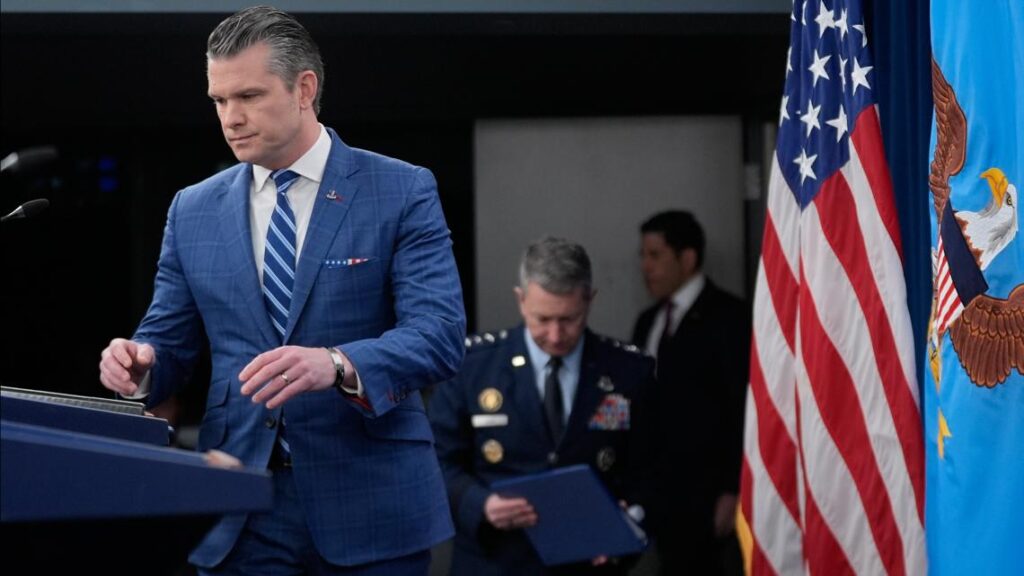
Defense Secretary Pete Hegseth announced the launch of Project Freedom, which they said is designed to ensure safe commercial traffic through the Strait of Hormuz.
WASHINGTON — Defense Secretary Pete Hegseth on Tuesday announced the launch of Project Freedom, a U.S. military effort established to ensure safe passage through the Strait of Hormuz.
The military operation is distinct from Operation Epic Fury and “defensive in nature,” Hegseth said during a Pentagon briefing. He was joined by Gen. Dan Caine, chairman of the Joint Chiefs of Staff.
It was revealed that roughly 1,550 commercial vessels, with more than 22,000 mariners aboard, were currently “trapped” in the gulf.
“We’re not looking for a fight, but Iran can not also be allowed to block international companies and their goods from an international waterway,” Hegseth stated.
The primary goal, according to the Defense Secretary, is to protect commercial shipping from attacks while passing through the strait.
Hegseth said Iran is the primary aggressor, attacking civilian and military ships indiscriminately, while soliciting tolls for passage through, and referred to their plan as a form of “international extortion.”
He also said he expected other countries to assist in the U.S. efforts for shared responsibility, saying “the world needs this waterway a lot more than we do.”
Iran has reportedly fired at commercial vessels nine times since the ceasefire was announced, seized two container ships, and attacked U.S. forces more than 10 times, Caine said at the briefing.
However, he stressed the attacks have not been significant enough for the U.S. military to consider restarting combat operations.
Hegseth and Caine have held several public briefings at the Pentagon since the conflict in Iran began on Feb. 28, when the United States and Israel launched an attack on the Middle East country.
The U.S. and Iran agreed to a short-term ceasefire on April 8, which was extended indefinitely at its end. However, the agreement is being tested this week, amid reports of attacks from all sides and escalating threats in the region.
The U.S. military on Monday launched an effort to defend commercial ships from Iranian attacks and “guide” them through the Strait of Hormuz.
Iran’s effective closure of the strait, through which about a fifth of the world’s trade in oil and natural gas typically passes, along with fertilizer and other petroleum-derived products, has sent fuel prices skyrocketing, rattled the global economy and proved a major strategic advantage in negotiations to end the war. Breaking that grip would deny Iran a major source of leverage.
Hegseth and Caine testified before members of Congress last week. It was the first time Hegseth had been questioned by elected officials since the conflict began.
The hearings Wednesday and Thursday before the House and Senate Armed Services committees delved into the Trump administration’s 2027 military budget proposal, which would boost defense spending to a historic $1.5 trillion. Hegseth and other Pentagon officials stressed the need for more drones, missile defense systems and warships.
This story is developing and will be updated.
The Associated Press contributed to this report.