
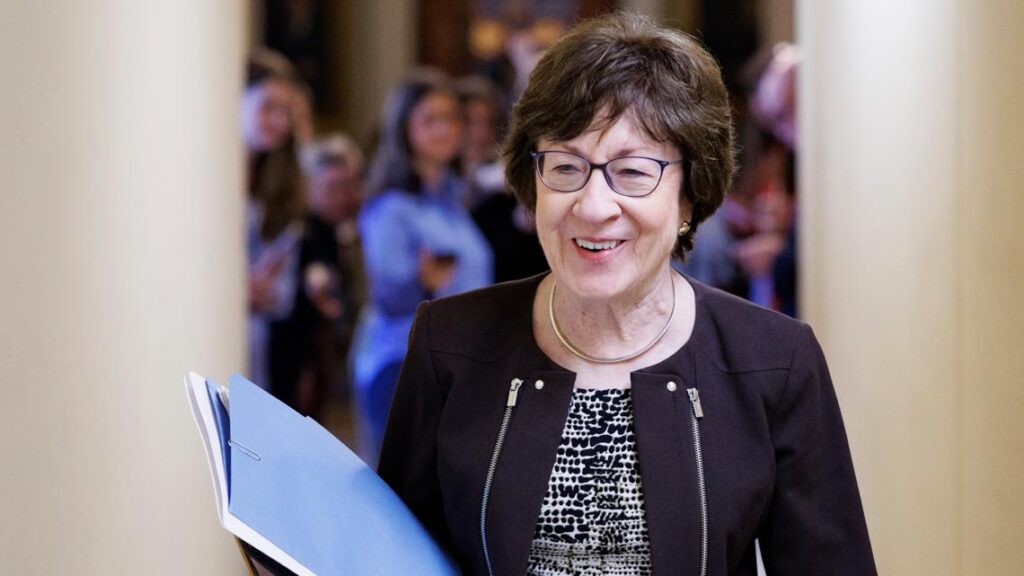
The 73-year-old senator, first elected in 1996, revealed in an exclusive interview she has a benign essential tremor that she treats with medication.
BRIDGTON, Maine — As she seeks re-election for a sixth, six-year term in the U.S. Senate, Republican Sen. Susan Collins is revealing a medical condition she has had for decades.
The 73-year-old senator, first elected in 1996, told NEWS CENTER Maine in an exclusive interview she has a benign essential tremor that she treats with medication.
While Mainers and Washingtonians might have noticed Collins sometimes has trembling in her hands or head or voice, the interview was the first time Collins discussed her condition publicly.
Medical experts say the condition is not associated with cognitive or memory decline.
“What I have is an extremely common condition that is called a benign essential tremor,” Collins said. “I have had it for the entire time that I have served in the United States Senate. It has absolutely no impact on my ability to do my job or on how I feel each day.”
Collins emphasized that she has never missed a Senate floor vote during her 30 years in office — a record approaching 10,000 consecutive votes — and she is confident, if she is elected again in November, in her ability to serve another six years.
“If you talk to anybody in Washington, they will tell you that I am the hardest-working person that they have ever worked with, and the fact is I’ve never missed a single vote in all the time that I’ve been honored to represent the people of Maine,” Collins said. “I think that’s pretty good evidence of the fact that I am blessed with great health.”
Like Collins, about 5% of adults over 40 have some form of essential tremor, as do 20% of those over 65, according to Dr. Rees Cosgrove, an expert on movement disorders and chief neurosurgeon at Mass General Brigham Hospital in Boston.
“It tends to slowly get worse over time,” Cosgrove said in an interview. “It’s not associated with other neurologic impairments. So, it’s not associated with cognitive decline or memory decline. It’s not associated with Alzheimer’s disease. It’s not Parkinson’s disease.”
When asked whether it is fair to say that an essential tremor is primarily just a physical condition and not a mental condition, Cosgrove replied, “Absolutely.”
“Sometimes these tremors can be both socially and professionally embarrassing,” the doctor said, but “not at all” incapacitating.
Her Democratic challenger, Graham Platner, 41, also faces questions about his health.
As he told a town hall in Sabattus last week, “I’m lucky enough that in my four combat tours, I was blown up enough times that the VA thinks I deserve health care.”
Platner told NEWS CENTER Maine in an interview last October, “I’ve got a couple herniated discs. My shoulder’s a wreck. My knees bother me. The VA gives me physical therapy for those things. I was also diagnosed with PTSD.”
The Veterans’ Administration has given Platner, who fought in Iraq and Afghanistan, a 100% disability rating, and Platner disclosed at the time that he collected a monthly disability payment of around $4,800 even though he earned a living as an oyster farmer.
It is important to note that a 100% disability rating doesn’t necessarily mean a military veteran cannot work.
“There are a lot of disabled combat or just disabled vets at 100% who still work,” Platner said in a November interview. “It’s a very normal thing.”
When asked whether the 100% disability rating would limit his ability to serve as a U.S. senator, Platner said, “No.”
In her new interview, Collins repeated that her condition has “zero impact” on her job or “ability to function.”
“It’s inconvenient at times, but that’s all,” Collins said.