
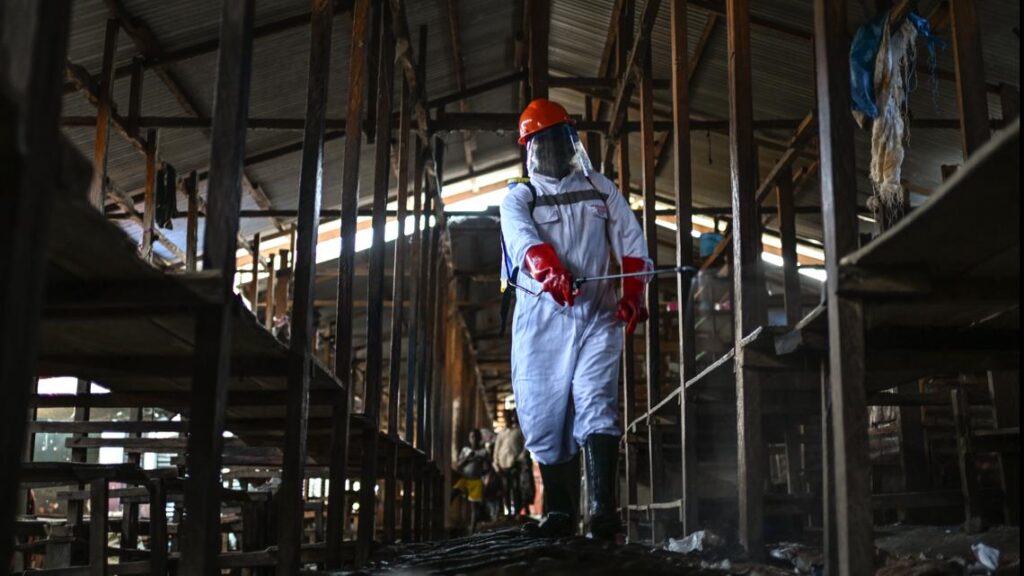
Officials have said the Ebola risk remains low ahead of World Cup travel. Harris County Judge Lina Hidalgo said the Houston area is prepared.
HOUSTON — Harris County Judge Lina Hidalgo said the Houston area is prepared and not in a state of alarm as officials monitor the global Ebola outbreak ahead of the 2026 FIFA World Cup.
Hidalgo shared an update Monday, emphasizing that local, state and federal agencies are working to stay ahead of any potential risks while keeping the public informed.
“We are OK,” Hidalgo said.
Hidalgo said the county is building on its experience from COVID-19 and past Ebola cases, working closely with health leaders to refine protocols.
She is also pushing for better coordination at airport screening areas and more detailed data on incoming travelers.
Recent arrivals to Houston
Hidalgo said seven Harris County residents who recently traveled to Uganda arrived back in the area over the past few days.
All were screened by the Centers for Disease Control and Prevention at Washington Dulles International Airport before traveling to Houston. None tested positive for Ebola, and none are showing symptoms.
Officials expect more travelers from affected regions to arrive in the coming weeks, especially as the World Cup approaches.
Houston is on the front line working to prevent Ebola exposure. Starting Tuesday, May 26, IAH will serve as the third screening point for US citizens returning from the Democratic Republic of Congo and neighboring countries.
The CDC said returning travelers will be escorted to a designated screening area where they will complete a questionnaire about their travel history and symptoms. They’ll have their temperature checked and be observed for signs of illness.
If none are present, they’ll be able to continue their journey. If symptoms appear, there will be further screening and be transferred to a hospital.
“It’s better to go through the processes and rather be dead or something like that,” London resident Teresa Akintunde said.
World Cup and travel concerns
Houston is set to host seven World Cup matches at NRG Stadium, along with a team base camp for the Democratic Republic of Congo. The team is also scheduled to play Portugal in Houston on June 17.
At the same time, the federal government has designated George Bush Intercontinental Airport as one of three U.S. airports to receive travelers diverted from Uganda, the DRC and South Sudan, where Ebola cases have been reported.
According to Hidalgo, the DRC has 101 confirmed Ebola cases, with a much higher number of suspected cases. Uganda has five confirmed cases, while South Sudan has none but remains at risk.
Travelers arriving from the three countries are screened by the CDC for symptoms, including fever, and must provide travel and contact information.
Risk to the public
Hidalgo stressed that Ebola is far less transmissible than COVID-19 and requires close contact with bodily fluids from a sick person.
“The likelihood of you or I getting Ebola from someone at airport security or by sitting next to somebody on the METRO on your way to the World Cup is extremely low,” she said.
She pointed to a 2014 case in Dallas, where only two ICU nurses contracted Ebola from a patient, despite close contact with family members.
“We have a playbook,” she said. “I feel confident about how things are going.”
Infectious disease experts said that for the average American, there’s no need to be alarmed. They said Ebola, unlike COVID or the measles, in the early stages, is not highly transmissible. It’s near the end of life where the virus is more highly transmitted, and that’s why we see healthcare workers contracting it.
Why not test everyone?
Hidalgo said widespread testing is not currently effective for Ebola.
Existing tests are designed for a different strain and may not be reliable.
The virus may not be detectable early in infection, even if symptoms are present.
Instead, officials rely on symptom monitoring and exposure history to guide response efforts.
Guidance for residents
Residents are urged not to panic or overwhelm public health resources.
Those without travel history or known exposure should follow normal medical guidance if they feel sick.
Anyone who has traveled to affected countries or had close contact with someone who has should contact Harris County Public Health.
Got a news tip or story idea? Email us at newstips@khou.com or call 713-521-4310 and include your name and the best way to reach you.