
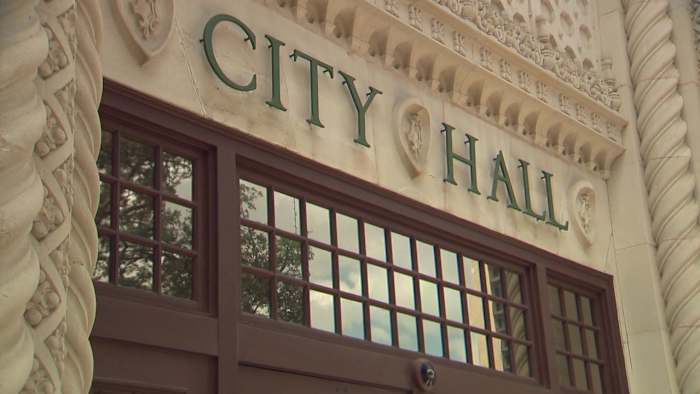
SAN ANTONIO – The San Antonio City Council is facing tough choices on how to close a looming budget deficit, including a possible a tax hike.
Facing a $131 million shortfall in two years, city staff recommended during a Friday budget discussion that council members consider maxing out the property tax rate in the upcoming fiscal year to help close the gap, though that plan would still require spending cuts.
Some council members are adamantly opposed to raising the tax rate, while others say the opponents need to be clearer in that case about what they want to cut.
“This is (an) absolutely non-starter for me,” Councilman Marc Whyte (D10) said. “Under no circumstances should we be raising the property tax rate on our citizens right now.”
“The balancing of the budget will require a comprehensive approach that includes both expenditures, reductions, and identification of new revenue opportunities,” Councilwoman Phyllis Viagran (D3) said a few minutes later in Friday’s meeting.
“But what I am not hearing from some council members is where we are going to cut — what you are willing to sacrifice — just what you’re willing not to do.”
What’s the max?
Property taxes make up about 28% of the revenue for the city’s general fund, which pays for many city services, like police, fire, libraries, and parks.
However, the city expects the overall taxable values to dip this year, which would mean less revenue unless the city raises the tax rate.
State law generally bars cities from bringing in more than 3.5% additional revenue from existing properties for its maintenance and operations without voter approval. However, the city has the ability to go even higher in its next budget because it didn’t always hit that cap in recent years.
If it maxes out the tax rate, the city says it would raise the current tax rate of $0.54159 per $100 of valuation by almost 3.5 cents up to $0.57648, which would be the highest tax rate since FY 2007.
At that rate, according to a city presentation, the average San Antonio homeowner would pay an additional $81 on top of their current $1,074 annual city tax bill.
The calculation appears to be based on a discounted, taxable value of $232,606 instead of the homestead’s full, appraised value.
City staff cautioned the estimates are based on preliminary data from the Bexar Central Appraisal District. The certified values aren’t expected until late July.
Close to 46% of homesteads in San Antonio are owned by seniors or people with disabilities, whose city property taxes are frozen and would be unaffected by a tax increase.
City staff tried to relate a tax increase to increased police and fire costs, which are popular budget priorities with residents.
Increased fire and police costs tied to collective bargaining agreements and benefits; equipment, technology, and fuel; as well as mandates and contracts are expected to cost another $77.2 million in the next budget.
Maxing out the property tax rate would bring in another $53.8 million.
Cuts are coming
Even maxing out the tax rate wouldn’t completely solve the city’s budget problems.
A scenario laid out by city staff still calls for $15.6 million in spending reductions over the next two years, which would be on top of the $10.6 million and 30 positions the city was already expecting to cut based on last year’s budget discussions.
Council members were reticent when it came to naming exactly which programs should be cut, though. Even Whyte, who is fond of saying the city has “a spending problem, not a revenue problem,” hedged his comments.
The Northeast Side councilman rattled off examples of city spending, such as $1.5 million for tenant relations and event coordination at La Villita or $500,000 to develop analytical tools, but qualified that “I’m not saying to cut all this, but a lot of these have ‘scrutinize’ next to it.”
“That’s what we need to be doing, looking at each one of these,” he said. “I bet you there’s millions of dollars just in these three pages that we could find.”
Mayor Gina Ortiz Jones said the city needs to find potential new revenue opportunities and find inefficiencies. She also raised the possibility of getting money from Spurs Sports and Entertainment through contract penalties for having failed to secure a Major League Soccer franchise.
“I’m open to it,” Jones told reporters about raising the tax rate, “but I need to be able to explain to folks, ‘Hey, we’ve done all of our due diligence,’ and we’re just not there yet.“
Next steps
City staff are expected to present a “trial budget” on June 18 that will take into account Friday’s discussions.
Though that’s typically a high-level look at the overall shape of the next budget, City Manager Erik Walsh told reporters it would be “a little more detailed.”
“I want to show what the actual reductions are,” he said.
Walsh said the budget may look different in terms of both spending and revenue.
“What you didn’t really see a lot of in there was other revenue sources we could tap. We talked about it, but we really need to do a little more work in those areas,” he said.
Staff will present a full, draft budget in August, and council members will pass a final spending plan and tax rate in September.
Read also:
Copyright 2026 by TheTXLoop – All rights reserved.