
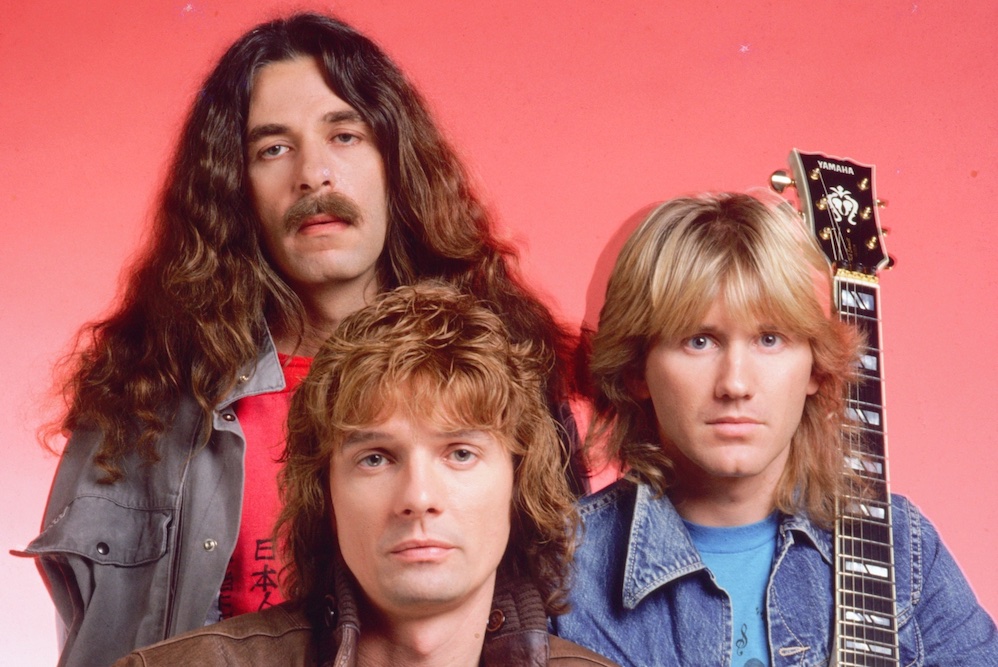
If you’ve lived in San Antonio long enough, the arrival of Triumph’s long-awaited reunion tour at Frost Bank Center on Thursday, May 21, will feel like a homecoming.
The hard-rocking band behind hits including “Lay It on the Line,” “Magic Power” and “Blinding Light Show” has been a local favorite since the era when Joe Anthony ruled SA’s airwaves and Stone City Attractions packed bodies into local concert halls.
And that’s because Triumph isn’t just popular in the Alamo City — the band literally got its stateside foothold here a half century ago. Its debut performance here in 1977 marked its first U.S. auditorium date.
How did the hit-making act go from a thrown-together spot replacing Sammy Hagar on a bill at Municipal Auditorium to an acrimonious breakup in the ’90s to this year’s ascendant reunion?
We talked to original guitarist-vocalist Rik Emmett and drummer-vocalist Gil Moore on Zoom to find out. In addition, we Zoomed with guitarist-vocalist Phil X, who — along with covering for Richie Sambora in Bon Jovi for roughly a decade — is one of three supporting musicians rounding out Triumph’s touring lineup.
If that wasn’t enough, the Current had a long talk with original bassist Mike Levine back in 2022 when the Triumph documentary Triumph: Rock & Roll Machine dropped. He was more than happy to reminisce how San Antonio contributed to the band’s rise.
“We did get a thing at the Alamo [in the ‘80s],” Levine explained. “They presented us with an award called the Emissary of the Muses. It’s like getting a key to the city. That was a special day for us. San Antonio was our second home, basically.”
“Ozzy pissed on the Alamo, and we got an award there.”
At the time of the interviews, scheduled before the first dates of the tour, Levine’s participation remained uncertain due to health issues. At press time, he hasn’t made any live appearances and it seems unlikely that he will.

Rock spectacle
For the uninitiated, Triumph is firmly grounded in staples of a rounded ’70s and ’80s hard rock diet: blues, folk rock and prog.
Moore and Emmett traded off songwriting and vocal duties, with Emmett leaning more toward reassuring, pastoral songs such as “Hold On,” “Magic Power” and “Blinding Light Show” — tunes that crossed a sense of whimsy with dexterous guitar riffs and soloing. Meanwhile, Moore brought the swagger via “Rock & Roll Machine,” “Allied Forces” and his crowd-pleasing cover of Joe Walsh’s “Rocky Mountain Way.”
The band formed in Toronto in 1975, and released its debut, In The Beginning, in 1976. The album featured “Blinding Light Show/Moonchild,” a nearly nine-minute epic that became arguably its most-beloved tune.
The second LP, Rock & Roll Machine, brought the title track into the repertoire and allowed Emmett to show off his impressive guitar chops. It would be used to anchor an unaccompanied guitar solo as the band ascended to arena god status in the ‘80s.
Though Triumph hit the scene as punk and new wave dominated, it firmly embraced the more-is-more ethos, treating the crowd not just with beefy hard rock, but also as much pyro and lasers as it could cram onstage. A Triumph concert became a spectacle in every sense of the word. The band grew in the hearts of fans, even though it never resonated with rock critics.
By the time the mid-to-late ‘80s rolled around, however, the edges began to fray. Emmett grew unhappy and looked for an exit.
His departure from working with Moore and Levine sparked a court battle and acrimony that lasted for nearly 20 years. The remaining members hired Phil X for one more album — 1992’s largely forgotten Edge of Excess — before petering out completely.
Moore opened Metalworks Studios near Toronto, and went on to success in the non-performing part of the industry. Emmett pursued a solo career that wasn’t unsuccessful, though it never reached Triumph’s heights, particularly in the States.
“I wasn’t happy with the way things had been going from about 1986 to 1988, you know, while I was still in it,” Emmett told the Current. “I had a lot of unhappiness there. I had a lot of unresolved kinds of things.”
He added: “Sometimes I think the human condition is such that we end up in situations where the only solution is going to lie within ourselves. For me, it was a question of having to find forgiveness.”
Moore had also reached the end.
“I had no intention of going back out and touring, because when I came off the road, it was intentional to want to be there with my kids while they’re being raised,” he said. “I wanted to look after my mother because my father had passed away, and I’m an only child. I wasn’t going to leave her alone and be in a hotel room halfway around the world.”
But fans never forgot.

Reunion stops and starts
Reunion requests followed the band members for years, and they finally worked things out for two 2008 gigs.
However, the shows at Rocklahoma and Sweden Rock Festival were under-hyped. While the band sounded great, many found it odd and disappointing that the DVD of the Swedish gig shows the members playing in the afternoon, sans pyro or lights, as if they were asked to fight with a hand tied behind their backs.
Wasn’t a reunited Triumph worthy of headlining gigs? Surely, things couldn’t end on this note.
But the band insisted those performances were definitely, positively it.
The members appeared together once more for a three-song studio set played to an audience of “superfans” for the documentary. But Triumph swore — swore! — any future shows were off the table due to age, physical limitations, costs and more.
So, when a Triumph reunion hit the newswire in 2025 as part of the Stanley Cup playoffs, the excitement was palpable. But, in the end, that gig was a letdown for many fans. Levine couldn’t attend for medical reasons, and Emmett and Moore, augmented by other musicians, at times felt like sidemen in their own band.
Combine that with musings from the band about a hologram tour, hopes for a reunion tour were dashed. Again.
And yet.
Triumph’s social media lit up earlier this year with long-awaited news of a tour. Fans were excited but understandably skeptical. Would it be the original trio? Holograms? A bunch of backing guys?
We now know the answer. Emmett and Moore have been open about age-related challenges — they’re both in their 70s — and the need for support from augmenting musicians. Even so, Even so, clips circulating online show the pair handling instrumental duties while handing off some of the sky-high vocal parts as needed.
The backing musicians weave their parts into the songs as essential elements but don’t overshadow the original members. And the usual pyro and spectacle got the invite this time.
Phil X is fully in action, playing guitar and bolstering the upper-register vocals, while Brent Fitz on drums and Todd Kearns on bass round out the sound. This means some songs feature two drummers, while others feature Moore fronting the band — a career first.
“Being onstage and being a fan, I have the best seat in the house,” Phil X told the Current of his place in the touring band. “It’s pretty amazing.”
There won’t be any setlist spoilers here, but suffice to say anyone who saw Triumph during the golden era can make the song calls fairly easily. And for anyone even remotely curious, multiple videos of the entire show circulate online.
“You learn stuff about yourself by kind of looking at your own history and going, yeah, you know, that was probably a mistake,” Emmett told the Current of the reunion. “And when you revisit the past, you’re getting a chance to rewrite it.”
‘Where it all started was in San Antonio.’
To understand what made Triumph’s pending Frost Bank Center reunion show possible — and so special — we need to go back to the beginning.
As its career heated up in the mid ’70s, the power trio enjoyed success in the Great White North, but the members wanted to get a foothold in the States.
“I think back to the earliest days when we were just, you know, three little greenhorn kids from Canada trying to get an audience,” Moore told the Current. “And that very first time that we came to San Antonio, we filled Municipal Auditorium right to the back seats.”
Back then, album rock stalwart KISS-FM and its star DJ and tastemaker Joe Anthony had Triumph’s tunes in regular rotation, and that raised the band’s profile in the Alamo City long before it was getting airplay nearly anywhere else Stateside.
The jolt of exposure here came from the track “Blinding Light Show,” Levine explained.
“It was like eight minutes long and (KISS) played the shit out of it,” he said. “Nobody played eight-minutes songs on radio unless it was ‘Stairway to Heaven.’ Which wasn’t even eight minutes!”
But that was just the beginning of San Antonio’s love affair with the band.
The next break came when the band got a surprise offer to replace Sammy Hagar after the Red Rocker was forced to cancel a show at Municipal Auditorium.
“We’ve got a gig in Buffalo a day or two before when we got the offer to replace Sammy,” Levine said. “That was a big cash gig for us, because it was 2,500 or 3,000 people in a club. We go, ‘Are we ready to play the Municipal Auditorium?’ It was either 5,600 or 6,300 seats. They had sold half of ’em when we got the call. We’re going, ‘How will we get our gear there? How are we gonna get there? How will we get work visas?’ We had a group meeting and said, ‘You know what? Let’s just go for it.’”
Emmett told the Current, the group felt the difference in the air when it arrived for the gig.
“We were wearing winter coats and stuff and we stepped off the plane and the smell of the air in San Antonio is, to a Canadian, tropical,” he said. “It was like, ‘Oh, my God,’ like it was this very warm, rich kind of air. We got a hotel downtown, and then got to go for a walk on the on the river. It was this crazy, magical, surreal thing that’s happening in my life that I’ve come here to play this gig.”
Behind the scenes, the KISS crew had to fight to get immigration papers for the band on short notice. DJ Lou Roney even pretended to be the band’s immigration attorney as he met with federal officials to expedite the process.
While Levine wasn’t familiar with the tale, he told the Current he doesn’t doubt it’s true — especially given the chaotic nature of KISS when Levine and the band paid their first visit to the station.
“It looks worse than a bar band trying to plug things in,” Levine recalled. “There’s cords running all over the floor.”
He continued: “We’re sitting there doing an interview and owned the station for the day, basically. And they bring in some album by some band I’d never heard of. Joe puts it on, and he listens for maybe — and this is live on the radio — 35 seconds and takes the arm of the turntable and scratches across the record, pulls it off and throws it against the wall. He goes, ‘That’s garbage. Next!’ He didn’t like it much. I was like, ‘Wow, that’s pretty serious stuff.’”
Then Municipal beckoned.
“There’s three Canadian guys that were scared shitless,” said Levine. “But when we walked onstage — the roar from the crowd — we just looked at each other like, ‘Holy shit!’ Everybody’s standing up. The balcony looked like it was actually moving with the crowd. We looked at each other and went, ‘Hmm, this might be pretty cool.’ Away went the fear.”
Moore credits the radio exposure and gig for helping break the band in an era before homogenized radio programming and YouTube ubiquity.
“You’ve got to remember back then it was all regional,” he said. “There’s no Internet. There’s no blowing up worldwide or blowing up across the country. You blow up regionally. That’s how it worked.
“Where it all started was in San Antonio.”

From hockey to a reunion
The years between the San Antonio breakthrough and the eventual breakup treated Triumph well — even though the band didn’t fit neatly into any box. The lyrics were uniformly positive, often focused on the value of community, self-actualization and uplifting takes on love and emotion. You didn’t get the “party hard” ethos of hair metal or the social commentary that marked the emerging thrash scene.
Albums such as Allied Forces, Never Surrender and Thunder Seven earned the band a massive fanbase, as did the accompanying tours. Triumph took part in the massive US Festival in 1983, arguably the band’s high-water mark.
But behind the scenes, things weren’t so copacetic, and Emmett bailed in 1988. Phil X, a longtime fan who’d grown up on the band, seemed like the ideal replacement and came onboard in 1992.
The reformulated trio played roughly 10 shows in support of the resulting album before calling it quits: an inglorious end for such a successful rock act.
Until 2008.
Levine told the Current that after Triumph’s initial reunion shows at Rocklahoma and Sweden Rock Fest, the group lined up 50-plus gigs for a full tour. But a recession gripped the U.S., and financial concerns scuttled the matter.
After that, the members felt they were simply too old to do it right.
But still the matter wouldn’t die. The song “Lay It on the Line” regularly featured in hockey commercials, and a Canadian broadcast company approached Moore about a Triumph reunion for a 2025 pregame performance.
By then, he was out of practice on his instrument, so he acknowledged the need for another player. That eventually led to the involvement of Phil X along with music-industry vets Fitz and Kearns.
The three-song gig hockey gig took place sans Levine, who had a medical appointment and separate media appearance already booked.
“We had one rehearsal and jumped onstage,” Moore said of the pre-show parking lot throwdown. “It was just like an electric thing that happened between the five musicians, where all of a sudden, we were like, ‘Hey, this kind of really works.’ And the audience lit up, everybody lit up, then [tour promoter] Live Nation lit up.”
The gig proved a turning point, especially for the still-reluctant Emmett, according to Phil X.
“I think that that kind of lit a little fire under his butt,” he recalled.
Around this same time, Moore got interested in hologram tours after checking out the ABBA production and looked into the possibilities for Triumph.
Behind the scenes, wheels began to turn, albeit slowly. As they did, Moore became increasingly interested in putting a real reunion together.
“Gil is kind of a genius-savant when it comes to anything Triumph,” Phil X said. “It’s insane. Just even talking to him about it.”
Finally, everything clicked.
“Of course, my kids get involved,” Moore said. “’Dad, you’ve got to do it. You’ve got to do it.’ And my wife, to be honest, of course. I’m like, ‘Are you just trying to kick me out of the house? Is this an easy way?’”
Moore began working out and rebuilding his chops. Then came rehearsals.
“It was just that magic,” Moore said. “You’re just hanging and having a coffee and rehearsing some background vocals and talking about stuff, and all of a sudden there’s this meeting of the minds where you realize, you know what, we’ve got a brotherhood here that’s just kind of coming together naturally, organically.”

Collaboration and inspiration
During the collaborative process, the Canadians did one of the things they do best: be polite. The musicians began insisting that someone else take this or that solo or vocal because they liked what the other person was doing.
The approach resulted in some radical rearrangements of Triumph’s material — something one might expect with the core musicians returning to the songs after decades away and now augmented by new players.
For his part, Moore is excited for his family to experience Triumph’s return.
“On this tour, my son-in-law, Craig, and my daughter-in-law, my eldest daughter and my granddaughter, they’re literally going to drive about two-thirds of the tour, if you can imagine it.”
Emmett resisted the idea that the reunion was about any one thing, though.
He agreed that surviving prostate cancer was a factor, as was being the final surviving member of his nuclear family. After all, the death of his brother inspired him to make up with Moore and Levine prior to the 2008 reunion.
However, Emmett emphasized that the songs remain his North Star.
“There’s things you can say like, ‘Oh, you know, I lost my brothers.’ But when I joined Triumph, I got my brothers back,” he said.
“More than that, I will say that it’s more fun to kind of be going back and revisiting the songs. The songs are the things that kind of keep dragging you back.”
The availability of the strong supporting cast was also a consideration.
“Now, anything that I can’t sing, I’ll just go, ‘Todd, Phil, you guys that can sing really high,’” Emmett said. “So, you know, if people are going to come expecting to see the Rik Emmett that pranced around in spandex pants in 1983, it’s not going to happen.”
No one likes assumptions, but it’s fair to say a 72-year-old in spandex is probably a hard pass — even for die-hard fans.
For his part, Phil X isn’t revisiting or rewriting anything, particularly his time in Triumph in the ‘90s for Edge of Excess. Emmett was a huge influence on him as a youngster, and he relished the chance to revisit the guitar parts.
“Rik Emmett was always like Jimmy Page on steroids, you know?” Phil X said. “And he grew to have more of his own style as he went down the line. I was getting ready, exploring and learning songs and arrangements. It took me to watching the US Festival in ‘83 on YouTube and it’s mind-blowing the way he played.”
But for all the memories the reunion tour evokes, San Antonio will always be a part of the band’s past and present.
“I’ve come back to San Antonio several times and played on my own,” Emmett said. “I played at [Sunken Garden Theater]. And I had told the guys, the sidemen in my band, that they’re going to want to learn ‘Blinding Light Show.’ We have to learn it, we have to play it.’”
The rest of the band dutifully learned the song, but didn’t quite grasp the significance. But, in the dressing room, as they waited to go on, they heard the chant rise from the crowd and understood: “The Blinding Light Show! The Blinding Light Show!”
Emmett turned to the band with a knowing look. “Like, I’m not an idiot. I knew what was what.”
Sign Up for SA Current newsletters.
Follow us: Apple News | Google News | NewsBreak | Reddit | Instagram | Facebook | Twitter | Or sign up for our RSS Feed
Related Stories

The Canadian hard rock act who enjoyed early success in San Antonio is hitting the city next May on its first tour in 30 years.

The band is the subject of the forthcoming documentary Triumph: Rock And Roll Machine, which will receive its U.S. debut on May 13.
