
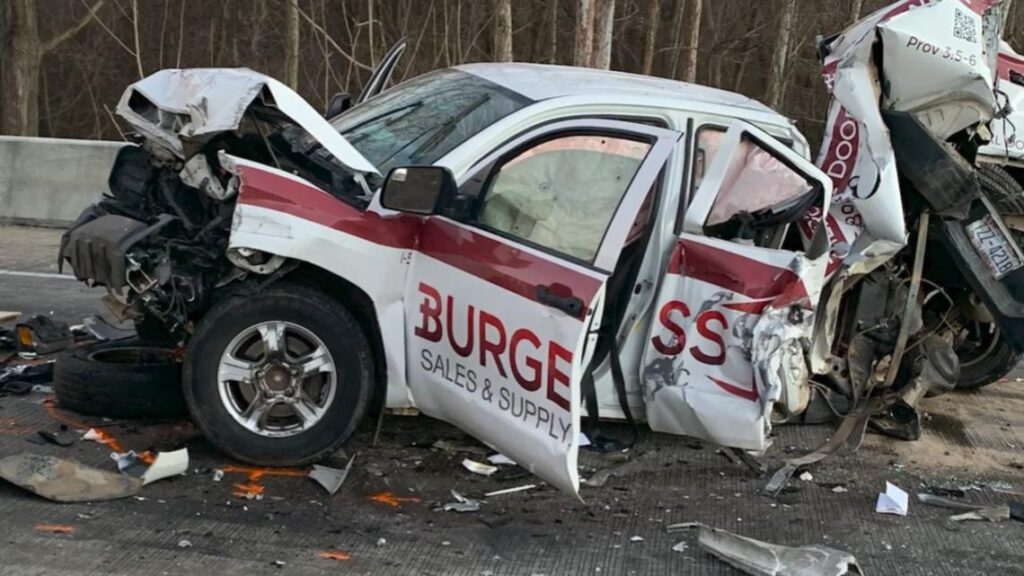
The Supreme Court ruled that freight brokers can be sued for hiring unsafe trucking companies in deadly crash cases.
DALLAS — The U.S. Supreme Court ruled unanimously Thursday that freight brokers accused of hiring unsafe trucking companies can be sued after deadly crashes, a decision that could reshape accountability across the trucking industry.
The ruling comes one day after WFAA aired an investigation examining the high-stakes case and what it could mean for families pursuing claims after catastrophic semi-truck crashes.
In Montgomery v. Caribe Transport II, LLC, the Supreme Court ruled that federal law does not block state lawsuits against freight brokers that arrange shipments with trucking companies involved in crashes.
At issue was the Federal Aviation Administration Authorization Act, or FAAAA, a federal deregulation law that the trucking industry has long argued protects brokers from liability in state courts.
Justice Amy Coney Barrett, writing for a unanimous court, said states still have the authority to regulate safety involving motor vehicles.
“A claim that one company negligently hired another to transport goods is not preempted by the FAAAA because States retain authority to regulate safety ‘with respect to motor vehicles’ under the Act,” Barrett wrote.
The case grew out of a 2017 crash in Illinois in which Shawn Montgomery lost part of his leg after a semi-truck struck his parked tractor-trailer. Montgomery sued freight broker C.H. Robinson, alleging the company negligently hired Caribe Transport despite safety concerns tied to the carrier.
The Supreme Court reversed a lower court ruling that had dismissed the claim.
The decision could have broad implications across the trucking industry as families involved in deadly crashes increasingly argue brokers should share responsibility when they hire carriers with histories of safety violations.
The court’s opinion repeatedly emphasized the connection between broker decisions and highway safety.
“All agree that common-law duties and standards of care form part of a State’s authority to regulate safety,” Barrett wrote.
The opinion also pointed to allegations that Caribe Transport had a “conditional” federal safety rating and problems involving drivers, hours-of-service compliance, maintenance and crash history when it was hired.
Based on those allegations, the court said Montgomery claimed C.H. Robinson “knew (or should have known) that choosing Caribe Transport to transport goods was reasonably likely to result in crashes that would injure others.”
In WFAA’s investigation that aired Wednesday night, families and attorneys described the case as one that could determine whether victims can continue pursuing broker liability claims in state courts.
The story highlighted concerns from safety advocates who argue brokers sometimes continue hiring carriers with documented safety problems, including poor inspection histories, crashes and federal safety violations.
Safety advocates praised Thursday’s ruling.
“This is a massive win for truck safety,” said Zach Cahalan, executive director of the Truck Safety Coalition. “TSC applauds the court for this common-sense decision that will help save lives and ensure truck crash victims and survivors receive the help and assistance they deserve following these horrific, preventable crashes.”
The justices ultimately sided with Montgomery, concluding negligent hiring claims involving unsafe trucking companies fall within the FAAAA’s safety exception.
“Requiring C.H. Robinson to exercise ordinary care in selecting a carrier, therefore, concerns’ motor vehicles—most obviously, the trucks that will transport the goods,” Barrett wrote.
The court rejected arguments from the trucking industry and the Trump administration that the decision would open the door to all kinds of lawsuits against brokers. Instead, the justices said the ruling is limited to cases involving truck safety.
“The safety exception saves only a subset of preempted claims: those involving regulations concerning motor vehicle safety,” the opinion said.
The justices also rejected arguments that they should narrow the law’s language to avoid inconsistencies elsewhere in the statute.
“Better to live with the mystery than to rewrite the statute,” Barrett wrote.
Justice Brett Kavanaugh, joined by Justice Samuel Alito, wrote separately to say the case was “close,” but concluded Congress did not clearly eliminate those state-law claims. Kavanaugh acknowledged brokers’ concerns that increased litigation and insurance costs could ripple through the economy, but said the law still allows those lawsuits to proceed.
The decision resolves a split among federal appeals courts. The Seventh and Eleventh Circuits had ruled that brokers were protected from those claims, while the Sixth and Ninth Circuits allowed them to proceed.
The ruling is expected to increase scrutiny of freight brokers’ safety vetting practices and could expand litigation involving broker liability after major trucking crashes.
For families pursuing claims after deadly crashes, the decision keeps a key legal avenue open.
The case now returns to lower court proceedings.