
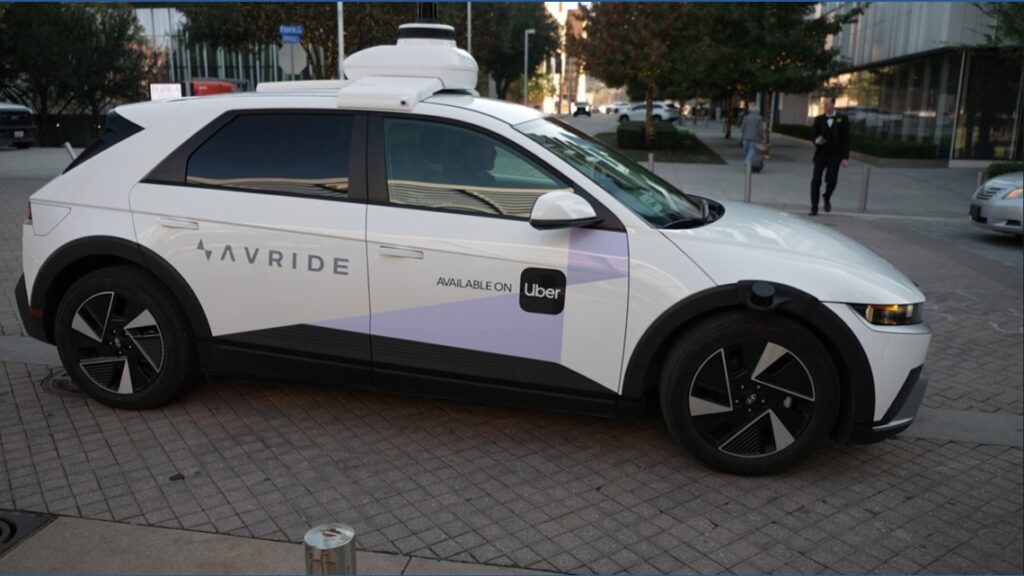
Videos of the crashes reportedly show instances of the vehicles changing lanes into the paths of other cars and failing to stop or slow for stopped or slowed cars.
DALLAS — Uber rolled out its Avride robotaxis in Dallas last December, but now, Avride’s automated driving system (ADS) is being investigated after several crashes, officials say.
According to the National Highway Traffic Safety Association (NHTSA), the Office of Defects Investigation (ODI) received multiple reports of automated vehicles crashing while Avride’s ADS was engaged in both Dallas and Austin.
“Each of the crashes involved the competence of the ADS with respect to performing at least one of the following driving behaviors: changing lanes, responding to other vehicles present in or entering the lane ahead, and responding to stationary objects partially obstructing the lane ahead,” NHTSA said in a statement.
ODI has preliminarily reviewed videos of every crash, officials said, showing instances of the vehicles changing lanes into the paths of other cars, failing to stop or slow for stopped or slowed vehicles ahead of them, failing to avoid vehicles entering their lane ahead of them, and colliding into stationary objects partially in the lane or path.
According to NHTSA, these crashes have caused property damage and one reported minor injury.
“During each of these crashes, the AVs were operating with the ADS performing the dynamic driving task while under the supervision of an in-vehicle operator in the driver’s seat,” NHTSA said. “The ADS performance in these crashes may indicate inappropriate assertiveness and insufficient competence to execute these driving behaviors in a safe manner and may also constitute traffic safety violations.”
ODI’s preliminary evaluation into the Avride ADS will determine the scope, severity and nature of potential problems and assess possible safety risks to passengers and others on the road, NHTSA said.
Avride issued this statement in response to the investigation:
“Avride is aware of the Preliminary Evaluation opened by NHTSA. We welcome the opportunity to provide the agency with a deeper understanding of our safety protocols and technology. Transparency is a core value of our operations, and we look forward to a constructive dialogue that supports the continued progress of the autonomous vehicle industry.
“We report incidents involving our vehicles to NHTSA—regardless of fault or severity—as part of our commitment to transparency and in accordance with applicable rules. In every reported incident, the vehicle was under the supervision of a trained safety operator on board. In most cases, the vehicle was traveling at low speeds and many of the events were precipitated by the actions of other road users. The alleged minor injury was not confirmed following our review through appropriate protocols.
“As part of our standard safety protocol, every incident undergoes a structured review that includes identifying and evaluating root causes. We have implemented targeted technical and operational mitigations to address our findings from each reported incident between December 2025 and March 2026, and have further enhanced overall system capabilities.
“Our total operations have continued to grow, while the frequency of incidents relative to our mileage has steadily declined. We remain committed to transparency with NHTSA, and other key stakeholders, as we continue to safely scale our operations.”