
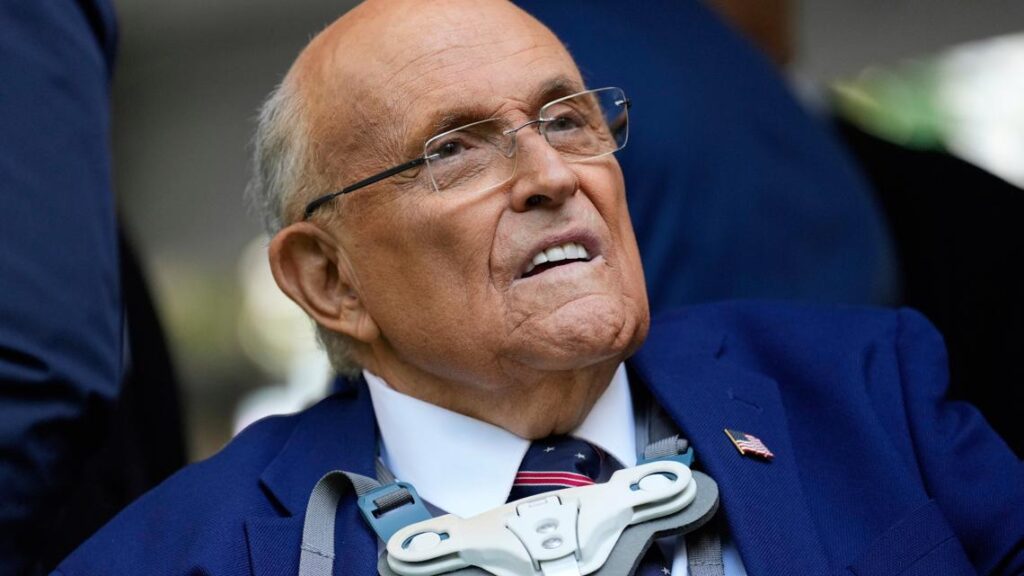
Giuliani, 81, is in the hospital in critical condition from pneumonia. According to his lawyer, the former mayor has reactive airway disease.
WASHINGTON — Rudy Giuliani is seeking health care coverage under a victim relief program designed to help those exposed to toxic dust on or after Sept. 11, 2001, his lawyer confirmed on Thursday.
The 81-year-old former mayor of New York and former legal representative for President Donald Trump remains in critical yet stable condition after he was taken to a Florida hospital over the weekend with pneumonia and put on a ventilator. Giuliani was still in the hospital on Thursday, although he has reportedly been breathing on his own, according to a spokesperson.
As the mayor of New York on 9/11, part of Giuliani’s political legacy and identity has been tied to his response to the attacks, which included visits to Ground Zero. Time Magazine named Giuliani its Person of the Year for his advocacy in the aftermath of 9/11.
However, that advocacy took a toll on Giuliani’s health. According to Giuliani’s lawyer, Michael Barasch, the mayor developed reactive airway disease, a pulmonary disease, from exposure to toxic dust after 9/11, leading Giuliani to apply to the World Trade Center Health Program.
“Mayor Giuliani is the poster child for the civilians who were exposed,” Barasch argued. “Those buildings were on fire for 99 days.”
The attorney argues that anyone who lived or worked downtown between Sept. 11, 2001 and May 2002 should apply for coverage. Barasch said about 300,000 civilians, who worked in the area, were impacted by toxic dust in the aftermath of 9/11.
That includes Barasch himself, who is one of the care recipients under the WTC Health Program. His office was, and still is, just three blocks away from the World Trade Center. Since 9/11, the attorney has been diagnosed with prostate cancer and squamous cell skin cancer. Barasch blames the Environmental Protection Agency, which, he said, told workers in lower Manhattan that the “air is safe.”
In a 2016 interview with the Guardian, President George W. Bush’s EPA Administrator during 9/11, Christine Todd Whitman, apologized to victims for the first time, arguing, “We did the very best we could at the time with the knowledge we had.”
Barasch and his firm, Barasch and McGarry, have represented more than 40,000 victims of the toxic dust that plagued the air after 9/11. According to Barasch, Giuliani first asked the attorney for help about a year ago.
Among Barasch’s most notable clients was James Zadroga, a New York Police Department officer who died of a respiratory disease in 2006 linked to his first-responder work at the World Trade Center site.
In 2011, President Barack Obama signed the Zadroga 9/11 Health and Compensation Act to aid first responders, named in the officer’s honor.