
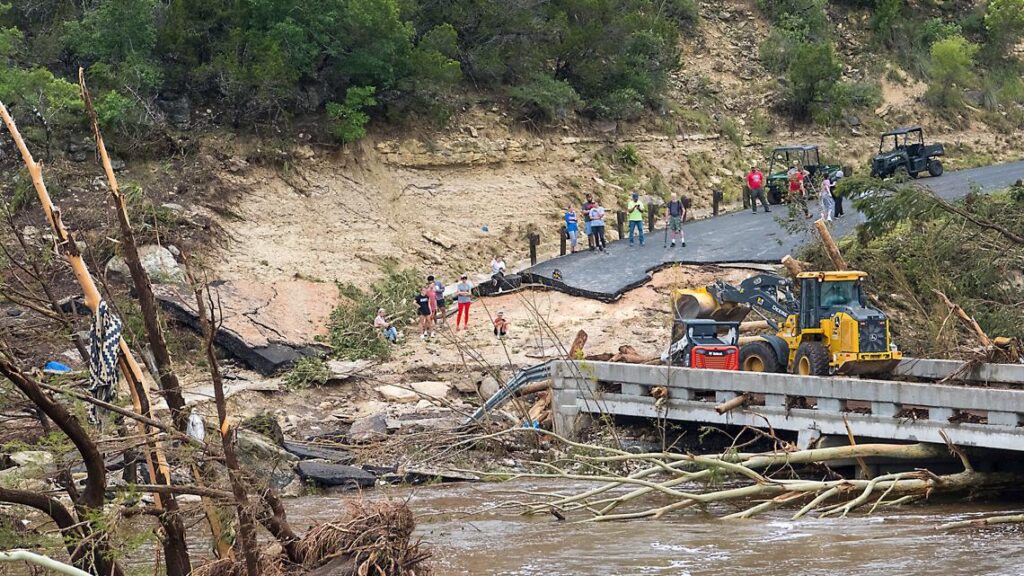
UT-Arlington partners with Rice University to develop a faster, more predictive flood warning system to enhance safety in flood-prone areas.
DALLAS — The University of Texas at Arlington is now involved in keeping another Hill Country flooding catastrophe from ever happening again.
UT-Arlington, in cooperation with Rice University in Houston, has received a $4 million grant from the Office of Governor Greg Abbott to create a real-time flood warning system that is faster, more predictive, and able to offer first responders and citizens more lead time in the event of serious flood events in the Texas Hill Country.
UTA’s Water Engineering Research Center (WERC), alongside Rice University’s Severe Storm Prediction, Education and Evacuation from Disasters (SSPEED) Center, is working to create and deploy a high-resolution, Texas-focused weather monitoring and modeling network “to deliver faster, more precise flood warnings in flood-prone areas.” It is focusing first on the Guadalupe River watershed where devastating flash floods in July of 2025 killed more than 130 people, with three still missing.
“The number one priority of our state is the safety of our fellow Texans,” Gov. Abbott said. “This grant will provide critical funding to enhance emergency alert systems. I thank UT Arlington for working to implement improved weather monitoring systems to provide Texans with accurate emergency warnings. Together, we will work to protect Texans and deliver a safer future for all.”
Nick Fang, the Robert S. Gooch Endowed Professor and director of WERC at UT Arlington, said “Texas faces some of the most complex and fast-moving flood risks in the nation.”
“By combining local monitoring with advanced modeling, we can reduce uncertainty and deliver actionable information to decision-makers when every minute counts,” Fang said.
Philip Bedient, director of the SSPEED Center at Rice, said their hope is that the system will provide anywhere from one to maybe as much as three hours lead time. The system will use radar rainfall data and hydraulic models to forecast floods at specific locations with greater accuracy and speed.
“Texas Tech, as part of their project, will be installing three new radars in the Hill Country, which will, I think, greatly add to the accuracy. So it’s a combination of accuracy and lead time,” Bedient said.
The SSPEED Center draws on its 20 years of experience protecting high-risk, flood-prone areas like the Texas Medical Center in Houston, providing real-time flood mapping and warnings for hospitals and other facilities.
“We received this particular funding to really start from early spring this year and deliver by next year, September,” Fang said. “But we are trying our best to really make it a functional system to start with and can be utilized by the community. I mean, by the end of this summer as a framework. But obviously that’s not going to be the final version. We’re going to continue to refine the system.”
Bedient thinks the flood warning system is going to be great once it’s in place.
“But more importantly than that is we are going to work equally hard to develop the communication and the outreach to emergency managers,” Bedient said. “We’re going to work as hard on that side as we do on the monitoring side, because both have to be in place, both have to be working in order to save lives.”
The Texas Legislature passed multiple bills to address the flooding disaster, including Senate Bill 5 that appropriated $50 million to fund grants to assist counties, municipalities, and other local governments with the 30 counties identified in the disaster declaration to create flood warning siren systems and install additional flood gauges.