
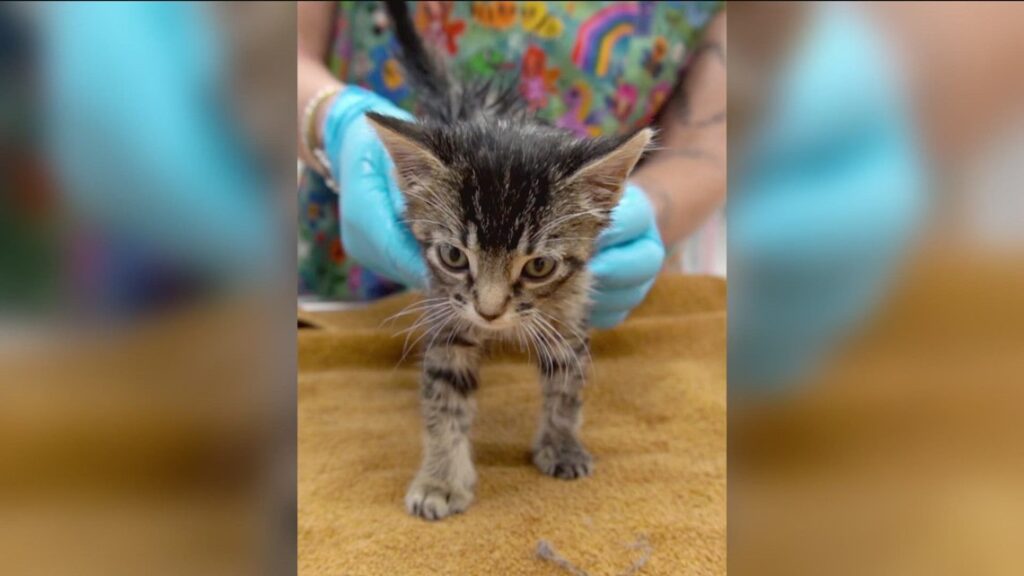
After a kitten became trapped and nearly died, animal welfare officials are warning sticky traps designed for mice and rats can be dangerous for all animals.
ENCINITAS, Calif. — A 6-week-old kitten is recovering at the Rancho Coastal Humane Society after nearly dying when she became trapped on a sticky rat trap in Anaheim, prompting animal welfare officials to warn against using the devices.
The kitten, now named Sticky, was about 4 weeks old when a good Samaritan heard rustling and discovered her stuck on a rat glue trap. She was dehydrated, cold and weighed less than a pound.
“The kitten was found by somebody. They heard a rustling, they heard a noise. They wanted to check what it was. They found this little kitten, probably about four weeks old at that time, stuck in a rat glue trap. Obviously, they’re not able to get out. The more they move, the more stuck they get. It was dehydrated. It was cold,” said Rancho Coastal Humane Society spokesperson John Van Zante.
The rescuer brought Sticky to Orange County Animal Care, where staff worked to free her from the trap and began using chemicals to remove glue from her fur.
Rancho Coastal Humane Society then stepped in to help. Shelter Manager Lilly Thacker drove to see the kitten and immediately decided to foster her.
“They told me ‘we have a kitten that was found in a glue trap. Do you want to see her?’ I said, ‘Sure, let me see.’ And I fell in love right away. And I was like, ‘I’ll take her,'” Thacker said.
Sticky receives daily baths with mineral oil to dissolve remaining glue and is encouraged to eat frequently. Thacker weighs her daily to monitor weight gain. Though still under one pound, the kitten is showing signs of improvement.
“She’s gotten a lot more confident. Before, she just liked to cuddle up on someone’s neck or chest and just sleep. Now, she’s getting very playful and adventurous, and she’s wanting to explore more,” Thacker said.
Staff warns that sticky traps designed for mice and rats are inhumane and dangerous for all animals, creating a domino effect when predatory birds also become trapped trying to catch stuck prey.
“They come in, they get stuck to the trap. Nothing they can do. They can’t get out. In the meantime, here comes an owl or a hawk, and they see a kitten or a rabbit that’s not moving. They go in, they get stuck too, said Van Zante.
The timing is particularly concerning during kitten season, when cats frequently give birth. Experts suggest using alternatives like rat trap cages instead.
Sticky isn’t ready for adoption yet, though Thacker is considering keeping her permanently.
“If I decide not to adopt her, because that has been something I’ve been thinking about, I just love her so much,” she said.