
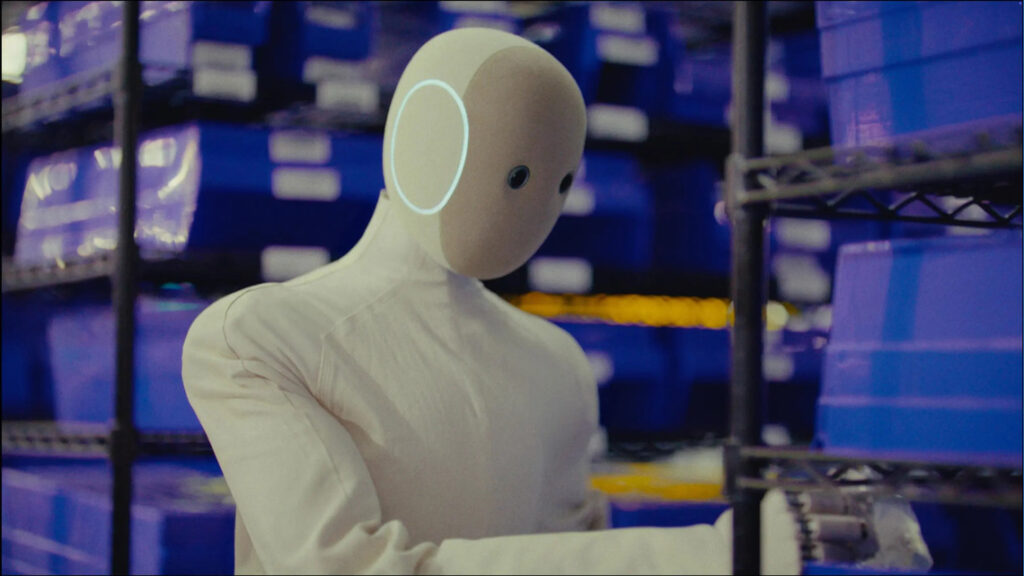
The company plans to produce up to 100,000 units annually, with early robots already assisting in factory tasks and data collection.
HAYWARD, California — The company behind one of the most talked-about humanoid robots says it is scaling up production. In some cases, they’re even using robots to help build more robots.
1X Technologies said it has begun full-scale manufacturing of its NEO home robot at a factory in Hayward, California, with plans to produce up to 100,000 units annually by the end of 2027.
The announcement comes just a few months after the company launched preorders for NEO, a humanoid robot designed to assist with everyday household tasks.
The $20,000 robot quickly sold out its initial production capacity, with about 10,000 units reserved within five days.
The company said the first robots will begin shipping in 2026, though some customers may receive theirs later.
NEO is built to function as a general-purpose home assistant, capable of tasks like cleaning, carrying items and basic household support. The robot stands about 5 feet, 6 inches tall, weighs roughly 66 pounds and uses cameras, sensors and artificial intelligence to navigate and interact with its environment.
At the center of the company’s push is its new factory, where many of the robot’s components—including motors, batteries and sensors—are built in-house.
But one of the more unusual developments is happening on the factory floor itself.
According to the company, early versions of NEO are already being used inside the facility to assist with basic tasks such as stocking parts and handling logistics. The robots are also collecting real-world data to improve their performance.
Over time, the company said those roles could expand to include security and more complex operations, effectively allowing robots to contribute to building future versions of themselves.
“Long term, the possibilities are near limitless,” 1X Technologies said. “We are incredibly excited to share regular updates as NEO evolves from factory assistant to a true general-purpose robot—one that will eventually handle everything from household chores to building robots, supporting chip fabs, powering data centers, and more.”
The approach may be a sign a broader shift in the robotics industry, where scaling production is becoming a major challenge. For now, the company said it is focused on testing, refining and gradually increasing output before delivering the robots to customers.