
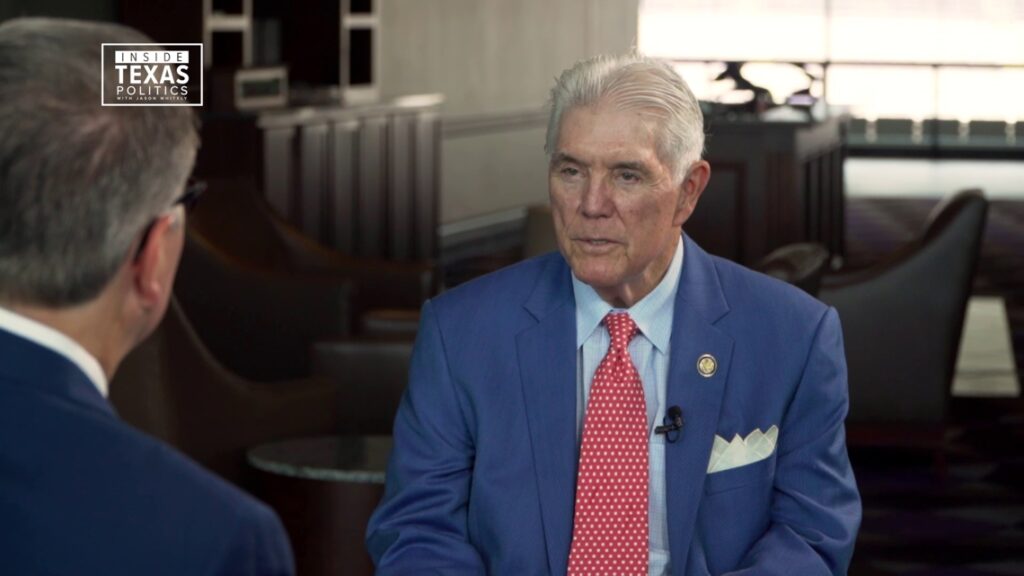
“It’s gonna give us a chance to sell the Metroplex,” Rep. Roger Williams said.
DALLAS — To say U.S. Rep. Roger Williams, R-25th District, is excited by how much the World Cup will juice the north Texas economy would be an understatement.
The chairman of the House Small Business Committee, and a small business owner himself, calls it a “once-in-a-generation opportunity” for large and small businesses alike.
“The great thing about something like this, it’s like starting a new business or a plant in your community. There’s so much what I call trickle-down economics, where people, smaller businesses will generate more than they would have otherwise. It’s gonna be fantastic,” he told us on Inside Texas Politics.
Williams and U.S. Rep. Beth Van Duyne, R-24th District, also a member of the House Small Business Committee, recently hosted a roundtable in Fort Worth to help businesses better understand the opportunities that will be available because of the World Cup.
They say they’d like to host three or four more business roundtables before the games begin June 30.
In an opinion article they wrote for the Fort Worth Star Telegram, the pair of lawmakers said the nine matches being hosted in north Texas are expected to have a direct economic impact north of $400 million, with a total regional impact of more than $1 billion.
Across the country, they say the World Cup is expected to produce more than $30 billion in economic output, add more than $17 billion to the nation’s Gross Domestic Product (GDP) and support about 185,000 jobs.
And sports is such a large part of North Texas’ economic engine, Williams says the World Cup will continue to help build “year-round tourism” long after the championship trophy is awarded.
“People may stop and buy a car. People may stop and decide they want to live here. I mean, there’s all kinds of trickle down that’s gonna happen. When you have dollars flowing in the private sector, dollars don’t get saved, dollars get spent,” Williams argued. “I think at the end of the day, you’re gonna see businesses of all sizes, especially small business, Main Street America. They’re gonna say this is pretty good.”
The lawmaker’s optimism comes in spite of a Houston Chronicle, ProPublica and Texas Tribune investigation that found that Texas taxpayers, particularly those in host cities Dallas and Houston, could be left paying the bill after the World Cup leaves town. Host cities have to spend hundreds of millions of dollars on everything from security at matches to changing stadiums to make them more soccer friendly. And yet, according to that investigation, those cities receive no revenue from tickets, merchandising, parking or concessions. Meanwhile, FIFA is expected to see $11 billion in profit from the World Cup.
A FIFA spokesperson provided a written response to the investigation that read: “The FIFA World Cup 2026 is projected to generate significant economic activity across Canada, Mexico and the United States, spanning tourism, hospitality, employment and long-term global visibility.”
Williams agrees, arguing that, while the games might cost some cities and businesses more in the short term, they’ll gain in the long term through new customers and increased visibility.
“It’s gonna give us a chance to sell the Metroplex,” said the Republican. “If you’re a business owner and you know you’re gonna have people coming in that don’t live here, that are extra, they’re extra customers, they’re extra entrepreneurs, there’s extra dollars. They’re gonna spend it.”