
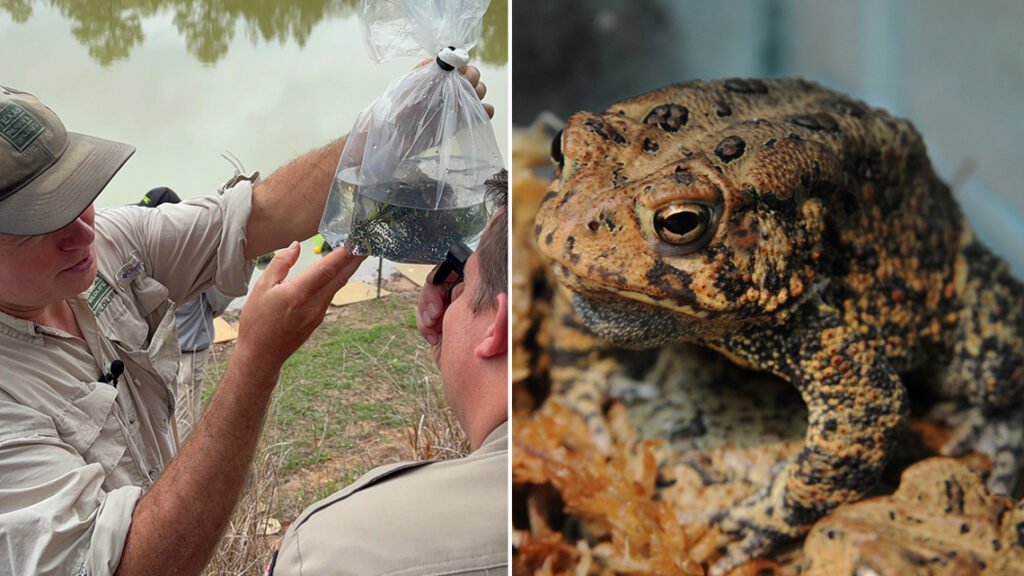
The Houston toad population disappeared in the five years following the devastating 2011 Bastrop County Complex Wildfire.
HOUSTON — More than one million endangered Houston toad eggs were released at Bastrop State Park as part of a renewed recovery effort led by the Texas Parks and Wildlife Department (TPWD), working with the Houston Zoo, Amphibian and Reptile Conservancy (ARC), and the U.S. Fish and Wildlife Service (USFWS).
This is a major push to restore the species to the park in years after the Houston toad population disappeared following the devastating 2011 Bastrop County Complex Wildfire. Officials said it has been about a decade since the park last had a resident population of Houston toads.
Conservation leaders said years of habitat restoration work helped make the reintroduction possible. There have been attempts in the past to restore the population. Those came in 2015 and 2019 but were unsuccessful.
Experts think this year is their best chance.
“We got close in 2019,” said TPWD herpetologist Paul Crump. “But this is the most eggs released in a single year to date in the state park.”
Restoration crews say habitat improvements in Bastrop State Park have brought the landscape back to conditions suitable for the endangered amphibian.
The eggs will be released in three sites — two in Bastrop County and one in Milam County.
“Each of these sites is managed a little bit differently,” said TPWD herpetologist Paul Crump. “Going forward, we can measure the varying success of these populations to determine what environmental factors are helping them along. Then we can try to replicate the most important of these factors in our other sites and across the state.”
The Houston toad was one of the first amphibians listed as federally endangered in 1970 due to habitat fragmentation and urban development. Additional threats, including drought, feral hogs, and invasive fire ants, have further reduced populations. Conservation officials say protecting and restoring habitat is critical to preventing extinction.
Got a news tip or story idea? Email us at newstips@khou.com or call 713-521-4310 and include your name and the best way to reach you.