
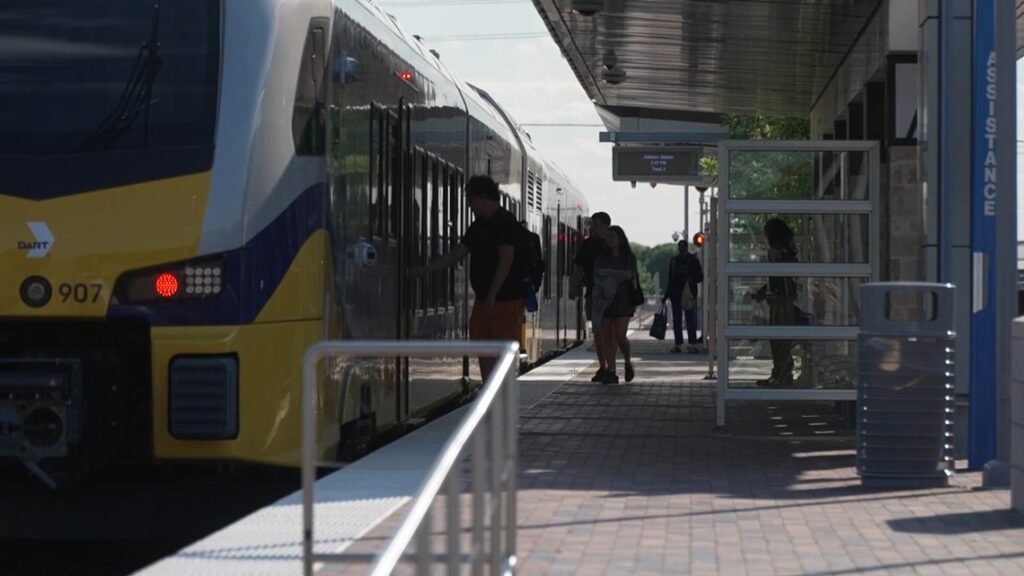
Highland Park voted to leave DART, ending local service May 14. Addison and University Park chose to remain in the transit agency.
HIGHLAND PARK, Texas — For months, the fight over DART has played out in city halls, board rooms and budget talks.
But at the Addison Transit Center, the election came down to something much simpler.
Could people still get to work?
Voters in Addison and University Park chose Saturday to remain part of Dallas Area Rapid Transit, while Highland Park voters decided to leave the regional transit agency. The split decision means service will stay the same in Addison and University Park, while DART service in Highland Park is set to end later this month.
DART said service in Highland Park will end May 14, after the town canvasses the May 2 election results during a special council meeting May 13.
At the Addison Transit Center, rider Athena Johnson said she was watching the results closely.
“I was really nervous that my only transportation to work was being taken from me, and it’s already stressful enough that it’s about an 1.5 hour commute, but I’d rather that than have nothing or to take a $70 Uber,” Johnson said.
The election results were the latest turn in a months-long fight between DART and several member cities over funding, governance and whether cities are getting enough out of the system for the tax dollars they contribute.
The push began after Plano announced plans to pull its tax contributions from DART. Plano, Farmers Branch and Irving initially set similar withdrawal elections but later canceled them after renegotiating agreements with the agency.
Highland Park now joins Coppell and Flower Mound as the three DART member cities to leave the agency since its inception in 1983.
“Currently we provide one bus route, primarily in the city of Highland Park,” DART Board President Randall Bryant said.
The withdrawal will affect Route 237, GoLink service, paratransit service and park-and-ride facilities within town limits, according to DART. Buses may continue traveling through Highland Park, but they will no longer stop there. The Park Cities GoLink zone will no longer operate within the town, and paratransit service to and from Highland Park will also end. Riders with recurring paratransit trips will be contacted directly by DART Mobility Management Services.
Bryant said Highland Park represents about 1% of DART’s current budget, but said the agency’s concern is not limited to the size of the service footprint.
“This was always our fear in this process, which is those that need the services the most, how can their voices be heard specifically in cities where they’re not voters or residents,” Bryant said. “Our responsibility is to ensure that they understand from DART that we can no longer, because of this democratic process, provide the services that they need.”
Johnson said that is the part of the debate she worries gets overlooked.
“It takes away people that are disabled, people that have low incomes, ability to get around the city, our city that we love. It’s not fair,” she said. “I’m saving to get a car after that winter storm. My car got totaled and it’s just like one less stressor to have my guaranteed transportation.”
DART’s interim CEO David Leininger said the debate with member cities has been difficult, but the agency is trying to look ahead.
“This whole issue that’s the board has been going through with the cities has really been challenging and I think there’s a real good opportunity now to look beyond that ,” he said. “We’re really thinking about what we can do together and not spending so much time debating what’s wrong.”
And the next stop in that may be in Austin.
“As we head into the next legislative session, we are united in our ask, give our cities room to breathe and allow the state to step in as a true partner in shaping what comes next,” Bryant said. “At the same time, we are pushing forward to expand our system and establish a fair, modern governance and funding model that works for everyone.”
DART said riders traveling to or from Highland Park should begin planning alternative transportation and may need to use nearby stops outside town limits. Riders could also see changes to travel times and connections.
“No matter if you are a resident of a member city, the broader region, or if you’re a tourist or whatever, you’re going to be impacted by the decisions that we make,” Bryant said.
The agency said GoPass, trip-planning tools and dart.org may take time to reflect the updates once service changes take effect. Route-level updates will be shared before service ends.
We’ve reached out to Highland Park for comment and are waiting to hear back.