
“This country is built on immigrants and is still building based on immigrants,” said immigration attorney Ral Obioha.
HOUSTON — June is National Immigrant Heritage Month, celebrating the contributions of immigrants to the United States. In Houston, about one in three residents are foreign-born, making it the most diverse city in the country.
There are businesses and groups working to make a difference for many immigrant communities in Houston and welcome them with open arms.
“The migrants bring to this country their culture and their warmth. We’re loving people. We’re hardworking people,” said Andrea Arana, the owner of Las Perras Café.
“This country is built on immigrants and is still building based on immigrants,” said immigration attorney Ral Obioha.
Immigrants like FIEL spokesperson Rose Escobar’s husband know that reality all too well.
“We’re actually trying to do things the right way,” Escobar said. “But there’s not a path.”
FIEL, the largest Latino-led immigration civil rights group in Texas, connected with Escobar after her husband was deported to El Salvador.
“I remember just saying, ‘No, no no,” and the phone dropped. It triggers me in so many different ways. I can’t even explain just going back and thinking about it,” Escobar said. “What I felt in that moment. And then I’m thinking, ‘What did he feel?’ I can’t imagine how that flight was for him, thinking he’s leaving behind his wife, his daughter, his son.”
FIEL Executive Director Cesar Espinosa worked with lawmakers to bring Escobar’s husband back. Espinosa, originally from Mexico City, was brought to the U.S. at the age of 5 and has lived in Houston for the past 33 years.
“I’m so grateful for what you did for me and my kids and my husband,” Escobar said. “We are living our American dream now, so I thank you for that, Cesar. You are my brother.”
Escobar’s family was fortunate. Espinosa said now ICE agents wait outside immigration courts in unmarked clothing to pick people up.
“It’s like legal kidnapping. Over 60% of people who are getting detained by ICE are people without a single criminal record,” Espinosa said. “About 1.2 million of us live in mixed-status families, meaning that some folks have papers, some folks don’t, and some folks may still not have papers. Out of those folks, 600,000 are undocumented. That means that one out of every ten Houstonians is undocumented. Houston is the Mecca of immigration. Whatever policy works – or doesn’t work – in Houston is going to dictate what the rest of the United States is going to look like in five years.”
Obioha said some of her clients are harassed while going through customs.
“Immigrants are like, ‘even if I’m a U.S. citizen, if they got a green card last week, last year, or two years ago, am I going to get deported?’ I got a call from someone last week who was coming back on an F1 student visa, and just because he had a laptop from his workplace – it was property – he was banned and sent back to his home country of China,” Obioha said.
For the past 15 years, Obioha has helped thousands of immigrant clients. But more recently, she said about 60% of them have expressed concerns about their case status.
“We had the DACA, which allowed people who came here young and were going to school in the United States… they were able to stay and benefit from that,” Obioha said when asked about the difference between the Trump administration and previous administrations. “Biden tried to do the Biden Parole Program, which was going to forgive people who had entered illegally if they had, you know, a relief available to them. All that has been scrapped by this current Trump administration.”
“Everyone needs to go through due process. Every immigrant should have an immigration lawyer that they trust – on speed dial though. Immigrants bring so much value,” Obioha said.
Value and culture are also represented in the family pictures Arana has displayed at her café.
“Those pictures are a reminder of my family and everything that I’ve been through. But I just think when you’re an immigrant, you don’t need a picture. It’s in you,” Arana said. “My mom’s side of the family, my grandpa’s side of the family, they were all farm workers. They would go from El Paso to Arizona to California every year.”
Arana also cares about advocating for her community. She occasionally hosts free community events at her café.
“I wanted this to be like a love letter to my culture, and I wanted people to be seen and safe when they come into my space,” Arana said.
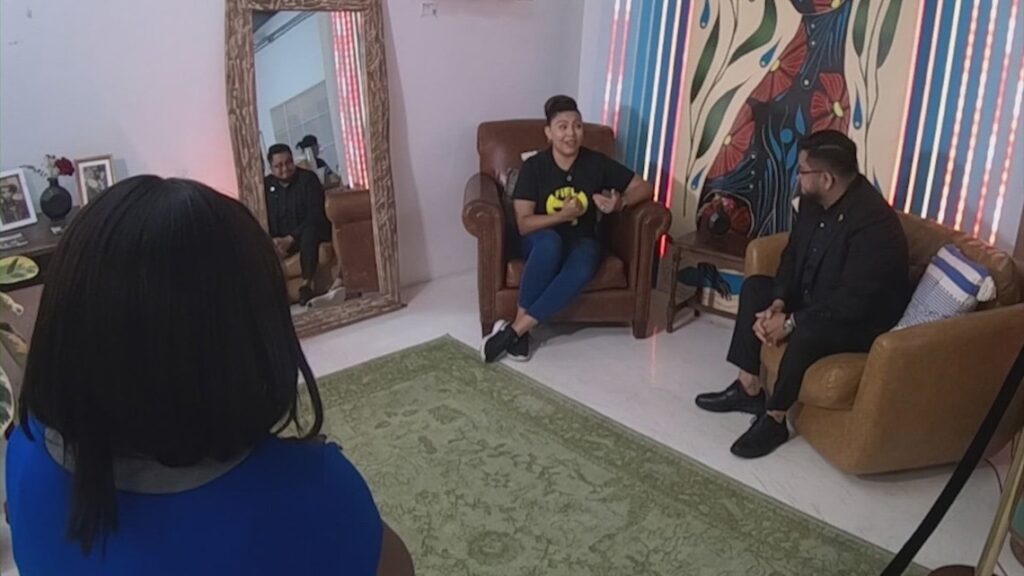
It’s why Escobar and Espinosa were interviewed at Las Perras Café.
“Rose embodies the spirit of what the immigrant community is like. When things are so much worse, when there’s no way or you don’t see a light at the end of the tunnel, we’re still very resilient,” Espinosa said.
“I just see so many people trying to survive financially, and to think about them also having to deal with the risk of one of their family members not coming home, it’s just something that I can’t even wrap my head around,” Arana said.
An emotional sign of solidarity.
For more information on FIEL and immigration attorney services, visit: