
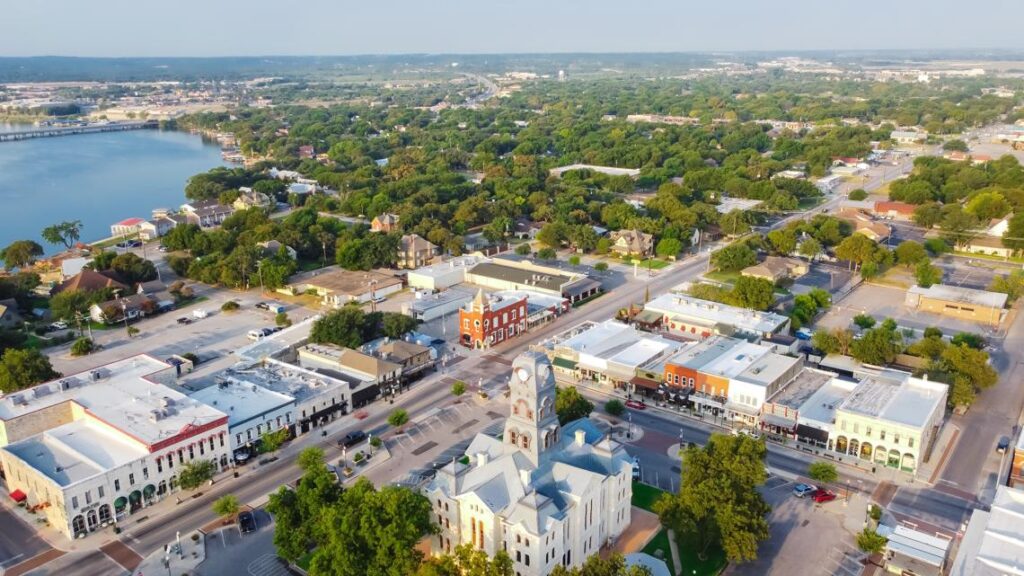
Hood County Judge-elect Mark Lowery led a town hall on Wednesday night in Granbury to discuss ways to manage or slow the data center boom.
GRANBURY, Texas — Hood County Judge-elect Mark Lowery ran a successful campaign that included opposition to the proposed proliferation of data centers in the county. And Wednesday night, he moderated a third town hall meeting, this time in Granbury, to explain why he believes a moratorium on data center projects can still happen.
Residents in Hood County are pushing back against a proposed data center development near Granbury, with some local officials and community members warning that the project could permanently change the character of the area.
The proposed development closest to Granbury, known as Project Patriot, would be built on approximately 2,100 acres along U.S. Highway 377 on the former Knox Ranch property, about three miles from downtown Granbury.
Four Granbury residents have filed a lawsuit against the city of Granbury’s leaders regarding plans to build the data center.
The lawsuit filed against Granbury Mayor Jim Jarratt, Granbury Mayor Pro Tem Bruce Wadley, Granbury City Manager Chris Coffman, and Granbury City Council Members Angela Parker, Skip Overdier, Zeb Ullom, and Greg Corrigan, alleges that taxpayers and ratepayers in Granbury and Hood County are being forced to pay taxes for the annexation of Knox Ranch for the construction of and approval of a data center without proper notice to the public. Court documents also say the plaintiffs are seeking to restrain the use of public funds illegally obligated under the annexation. Residents in the lawsuit state they found out about the annexation of property in December of 2025 through social media, without formal public notice.
But it is only one of eight data centers in development for Hood County, from Tolar to Pecan Plantation.
“I am against it,” said Hood County Judge Elect Mary Lowery, of the data center projects. “I have been against it. I thought about it for a period of time before I took that strong stance.”
Residents in neighboring Hill County have voiced similar concerns about the rapid growth of large-scale technology and energy infrastructure projects.
“Noise pollution, light pollution, industrial waste — everything these folks have pointed out,” Hill County resident Lowell Williams said at a Tuesday night meeting where Hill County Commissioners approved a one-year moratorium on new data center construction.
Hood County commissioners considered, but did not approve, a similar measure last month after State Sen. Paul Bettencourt warned county officials that counties may not have broad constitutional authority to enact such moratoriums.
Despite that warning, Lowery said he intends to continue pursuing options to slow development.
“You know the fight’s not over until it’s absolutely over, and I don’t believe we’re there yet,” he said.
Lowery said he plans to push for another vote on a possible moratorium of six months to a year, arguing that the county needs time “to get our legs underneath us” and best determine how to manage future growth.
“In my mind, this is about protecting the beautiful community we live in and generations to come,” Lowery said.