
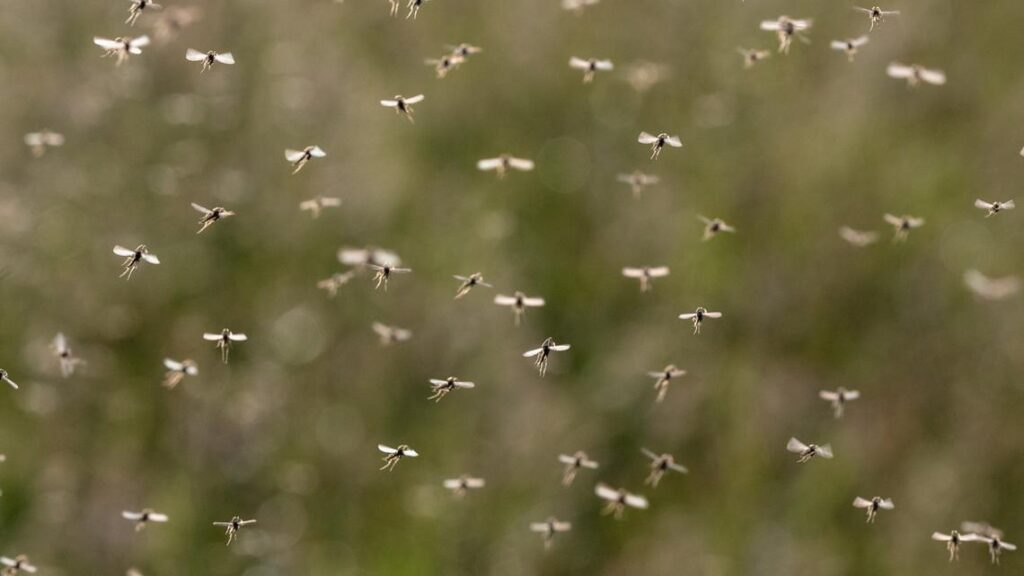
Google’s lesser-known “Debug” initiative seeks to release up to 32 million specially treated mosquitoes in Florida and California over the next two years.
ST. PETERSBURG, Fla. — Google is asking federal regulators for permission to release up to 32 million specially treated mosquitoes in Florida and California over the next two years as part of an ambitious effort to curb mosquito-borne diseases.
The proposal, currently under review by the U.S. Environmental Protection Agency, is part of Google’s lesser-known “Debug” initiative, a project launched more than a decade ago to develop new technologies aimed at reducing populations of disease-carrying mosquitoes.
The plan calls for releasing male mosquitoes infected with Wolbachia, a naturally occurring bacteria that prevents viable offspring when the males mate with wild females. Because only female mosquitoes bite humans, experts say the releases would not increase the number of biting mosquitoes.
“It’s a great concept, and we’re putting it to real use to see if it works,” said Chad Huff, public information officer for the Florida Keys Mosquito Control District.
Researchers say the latest proposal targets Culex mosquitoes, a species known for spreading West Nile virus and St. Louis encephalitis. According to the Centers for Disease Control and Prevention (CDC), West Nile virus is the leading mosquito-borne disease in the United States.
“None of these technologies are being talked about as particularly new,” Huff said. “The mosquito control industry has for some time been looking at what we call novel control techniques.”
Among those techniques are sterile insect programs that aim to reduce mosquito populations without relying solely on chemical pesticides.
“Wolbachia has been around for a while,” Huff said. “You can source mosquitoes that have been infected with Wolbachia and they’re only a danger to the mosquito itself. It doesn’t communicate to a person or anything like that.”
When a Wolbachia-infected male mates with a female mosquito, Huff said, “they’re just not able to reproduce.”
“That could cause a dip in the population,” he said. “And places that are trying this, that’s what they’re looking for — to be able to use this mosquito as a means to stop mosquitoes.”
The Florida Keys Mosquito Control District is already testing a similar approach.
“We are currently in our second year of trying it,” Huff said. “We did it last season, and we’re doing it again this season.”
The early results have been encouraging.
“It’s been promising enough that we wanted to look at it more,” Huff said. “Last summer we did it in a few selected areas and we had some pretty promising results.”
He said the district has observed reductions in mosquito populations in some test areas.
“We definitely see that there is a reduction in some areas,” Huff said. “It was promising enough last season that we wanted to look at it some more, so that’s what we’re doing this season.”
Residents interviewed by 10 Tampa Bay News expressed a mix of support and skepticism about Google’s proposal.
“I am kind of all for it,” said Tara Nye. “Anything to reduce the population here is number one on my agenda.”
Nye said the potential public health benefits make the idea worth considering.
“Mosquitoes are the number one death of humans,” she said. “I mean, why not help the human race?”
Christian Diprima was cautiously supportive.
“If it is proven to work and it’s going to keep them from breeding more, I guess it could work,” he said, later adding, “I’m for it.”
Others were more hesitant.
“You know, when you make a commitment like that, you really can’t step back from it,” said Alan Teschner, who questioned the potential health risks associated with such a large-scale release.
Brent Nye said he would prefer to see the technology tested elsewhere first.
“I think it’s interesting,” he said. “I’m not sure whether I would want them in my backyard because there are going to be a lot of things that go wrong. I’d rather have some other state to experiment on.”
Huff said concerns about increased mosquito bites are misplaced because male mosquitoes do not bite humans.
“A male mosquito has never bitten anybody,” he said. “It’s not like you’re releasing a male mosquito and it’s able to bite you.”
Google says artificial intelligence and robotic systems would be used to breed, sort and release the mosquitoes at a scale large enough to make the strategy effective.
The EPA is accepting public comments on the proposal through June 5 before deciding whether to approve the experimental use permit. Regulators have not identified where any releases would occur if the project moves forward.