
Brandon Mulder is a journalism fellow at the University of Texas Energy Institute.
Dozens of wind projects in Texas are in limbo after the U.S. Department of Defense paused issuing routine federal permits citing national security concerns, a move that experts say expands the Trump administration’s crusade against wind energy.
According to data collected by the American Clean Power Association, 54 Texas wind projects are waiting for the department to review development plans to ensure that turbines don’t interfere with military operations. It’s part of a broader nationwide logjam that has ensnared 165 onshore wind projects, a figure first reported by the Financial Times.
Federal law requires any structure 200 feet or taller — such as antennas, smokestacks or wind turbines — to be reviewed first by the Federal Aviation Administration, then the military, which must determine whether a structure may interfere with military airspace.
Federal law requires the Department of Defense to conduct those reviews within 60 days of receiving an application from the FAA. But “right now, the entire process has just ground to a halt,” said Dave Belote, a wind energy consultant who helped design the review system when it was established more than 15 years ago.
Normally, the defense department evaluates whether a turbine is within the line of sight of a radar or in a low-altitude military airspace. If so, the department and developer typically agree on mitigation options — a process that usually takes a matter of weeks.
“In the past, those have been fairly trivial — you meet the requirements and you get the permit,” said Jonathon Blackburn, an Austin-based energy consultant.
However, the department has not approved a wind project since August 2025, and in April the department canceled all pending meetings with wind developers waiting for clearance, according to the trade group.
These delays have caused disruptions to developers’ projects, hindering their ability to secure project financing, jeopardizing local permits contingent on federal approvals, and delaying construction timelines, turbine orders, and contractor scheduling.
“There’s a lot of delay coming out of the permitting process from the federal government, and delays add cost,” Blackburn said. “Maybe the federal government is not able to flat-out stop projects, but they are able to drag them out.”
In a statement, a DoD official said that the department is still actively evaluating the projects to ensure they do not impair national security or military operations, a process that requires high levels of interagency coordination.
The department’s evaluation of wind turbines “is inherently complex and time-consuming because it involves balancing two critical, and sometimes competing, interests: developing energy sources while ensuring military operations and readiness are not degraded or impaired to the extent an unacceptable risk to national security is created,” the official said.
The department didn’t respond to questions about why approval wait times have blown past federally required deadlines.
“It’s not clear why these policies are being implemented during an affordability crisis, but I think it shows the level of disdain the administration has for renewable energy in general and wind power specifically,” said University of Texas energy professor Michael Webber.
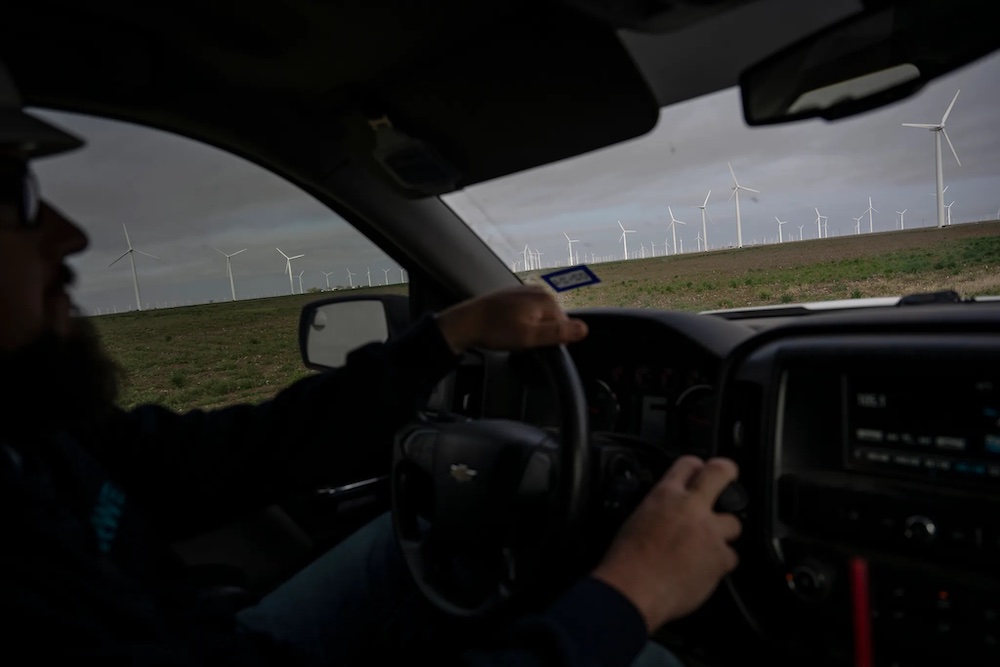
Texas is home to more wind turbines than any other state, and also has a number of military installations.
According to a 2019 report by the Texas A&M Natural Resources Institute, there are 17 military bases with flight facilities in the state and large expanses of airspace set aside for military operations. This includes several training routes for Air Force and Navy pilots flying out of Laughlin Air Force Base near Del Rio, the Naval Air Station in Corpus Christi, San Antonio’s Randolph Air Force Base and the Dyess Air Force Base in Abilene.
The pause is the latest move by an administration that is attempting to slow the growth of wind power across the U.S. Most of the administration’s efforts have focused on offshore projects.
Last year, the administration suspended leases for five major projects off the East Coast, citing national security concerns related to radar interference. Federal judges later ruled against the administration in all five cases, finding that the government exceeded its authority and failed to prove that the projects posed national security threats. All five projects have since resumed construction.
The Interior Department announced in March that it had reached an agreement with TotalEnergies to pay the company $1 billion to walk away from a planned offshore wind project and instead expand fossil fuel investments.
The Interior Department later negotiated similar agreements with two other offshore developers on the east and west coasts who agreed to terminate their federal leases in exchange for a combined $900 million payment from the U.S. government.
This article first appeared on The Texas Tribune.
Sign Up for SA Current newsletters.
Follow us: Apple News | Google News | NewsBreak | Reddit | Instagram | Facebook | Twitter | Or sign up for our RSS Feed
Related Stories

With consumer prices rising due to the United States and Israel’s war with Iran, interest in renewables and EVs is rising. Misinformation may be holding consumers back.

Utility-scale solar soared in 2025 across the country; coal also grew, while natural gas was down.

With gasoline and oil prices rising, U.S. consumers are already feeling the effects of the Iran conflict and the consequences of a slow transition to cleaner alternatives.