
AUSTIN (KXAN) — As soon as Wednesday, Austin city council could approve its budget for next fiscal year, and set a tax rate high enough to trigger an election.
Because of a 2019 state law, taxing entities cannot raise the property tax rate more than 3.5% from the year prior without triggering a tax rate election, or TRE.
That’s where the city manager’s base budget sits — at the 3.5% rate allowed without triggering a TRE — which would still mean a total increase of $218.16 annually for the “average” ratepayer and taxpayer.
City council and the mayor are considering asking voters to go higher than that, triggering a tax rate election in November, the month after the budget goes into effect.
How much would a TRE cost you?
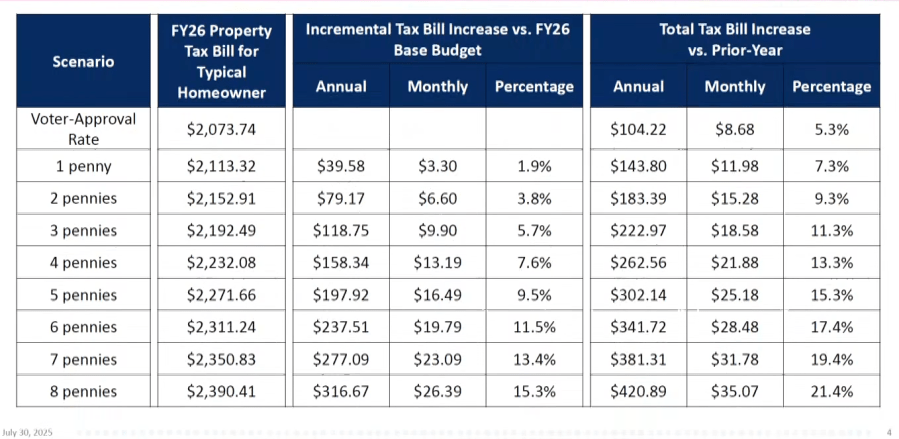
Before we get to the tax rate election proposals on the table, below is the breakdown from city of Austin budget staff of how much each penny (per $100 of value) would raise the average homeowners property tax bill.
The numbers below do not include the increase in cost for rates, which is something the city manager’s base budget does include.
The per-penny scenario is how leaders are presenting their tax rate election proposals.
Proposals on the table
Right now, the only council member outright against a TRE is Council Member Marc Duchen.
“I remain uncomfortable with the expensive proposals supported by the Council majority and therefore intend to vote against any budget that triggers a TRE,” Duchen said.
Austin Mayor Kirk Watson posted a new 5 cent (per $100 valuation) proposal Tuesday, but he said it was an attempt to compromise with the majority of council members who wanted to go above his previously pitched 3.5 cent plan and that he still prefers his less expensive proposal.
“My 5 cent proposal offers to fully fund our Homeless Strategy Office Plan without adding items outside that plan, increased funding to important public safety requests, and prioritizes our parks, among other basics,” Watson said.
Watson has told KXAN he will not vote for a TRE that funds anything but “core, basic services.”
Mayor Pro Tem Vanessa Fuentes and Austin City Council Members Ryan Alter, Chito Vela and Jose Velasquez also proposed a 5 cent tax increase Tuesday night — which tweaks the mayor’s proposal.
“We have recently put forward a proposal … that funds homelessness, funds affordable housing, funds social services and allows for further conversation on refining that for an ultimate budget adoption,” Alter said.
That group is suggesting their proposal be the base budget Austin city council works from Wednesday as it works through amendments.
Meanwhile on Monday, Austin City Council Members Krista Laine, Mike Siegel, Paige Ellis and Zo Qadri came down from their initial 5.75 cent proposal to a new 5 cent proposal. While it would cost the same as the mayor’s, it offers different services.
- Read the mayor’s proposal here
- Read Fuentes, Alter, Vela and Velasquez’ proposal here
- Read Laine, Siegel, Ellis and Qadri’s proposal here
“After consulting with a broad array of stakeholders, and with the goal of building a proposal that can win a strong supermajority of Council support, we’ve developed a 5 penny proposal that reflects both the urgency of this moment to invest in our city’s future and our shared responsibility to be careful stewards of public funds,” the group wrote Monday.
According to the above chart, all of these proposals, at 5 cents, would raise the average homeowner’s property tax bill by $302.14 annually. Again, that number does not include average rate increases — and it could go up or down as city council/the mayor add or take away line items.
Austin City Council Member Natasha Harper Madison’s chief of staff, Sharon Mays, told KXAN the council member is in favor of a TRE, but hasn’t supported a specific proposal yet.
“CM Harper-Madison is still in favor of a TRE; however, she’s more comfortable with the 5-cent option now. We’re monitoring the message board to stay current on the updates being posted by the other council offices. If a TRE happens, CM Harper-Madison wants to make sure that it’s an amount that the voters will pass,” Mays wrote.