
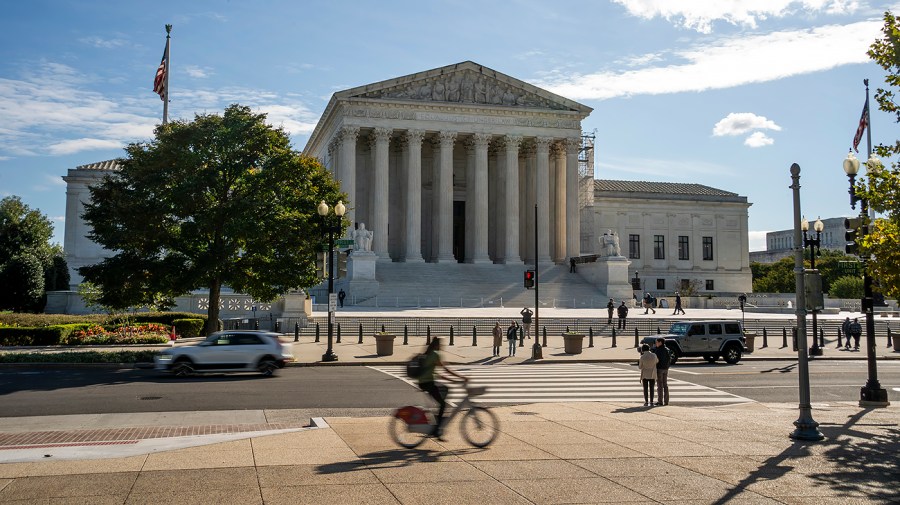
AUSTIN (KXAN) – The Supreme Court ruled 6-3 Friday to uphold Texas’ age verification law for pornographic websites, establishing precedent that will affect similar laws in more than 20 states.
In Free Speech Coalition v. Paxton, the justices applied “intermediate scrutiny” rather than the stricter constitutional review that adult entertainment advocates had sought, finding that Texas House Bill 1181 only “incidentally burdens” adults’ First Amendment rights while serving the state’s compelling interest in protecting children.
The Decision
Writing for the majority, Justice Clarence Thomas concluded that HB 1181 “triggers, and survives, review under intermediate scrutiny because it only incidentally burdens the protected speech of adults.”
The 6-3 decision, joined by Chief Justice Roberts and Justices Alito, Gorsuch, Kavanaugh and Barrett, represents a significant departure from how courts have previously analyzed online speech restrictions.
The law requires websites where more than one-third of content is “harmful to minors” to verify users’ ages through government-issued identification or transactional data before allowing access. Violations can result in fines for a website’s owner of up to $10,000 per day, escalating to $250,000 if minors access covered material.
The Dissent
Justice Elena Kagan authored a forceful dissent joined by Justices Sonia Sotomayor and Ketanji Brown Jackson, arguing the majority had abandoned decades of consistent First Amendment precedent requiring strict scrutiny for content-based speech restrictions.
“The majority’s opinion concluding to the contrary is, to be frank, confused,” Kagan wrote, criticizing the Court for creating “special-for-the-ocassion, difficult-to-decipher rules” to reach its preferred outcome.
The dissent argued that four previous Supreme Court justices involving similar restrictions on sexually explicit speech had consistently applied strict scrutiny, regardless of whether the laws imposed outright bans or lesser burdens on adult access.
Constitutional Framework Established
The Court rejected both the adult industry’s argument for strict scrutiny and Texas’s position that only minimal “rational basis” review should apply.
Instead, the majority crafted a middle path, ruling that age verification requirements fall under intermediate scrutiny because they regulate unprotected activity (accessing material obscene to minors without age verification) while only incidentally affecting protected speech.
“The power to verify age is part of the power to prevent children from accessing speech that is obscene to them,” wrote Thomas, comparing online age verification to longstanding requirements for purchasing alcohol, tobacco or adult materials in physical stores.
The majority emphasized that technological changes since earlier internet cases, like 2004’s Ashcroft v. ACLU, have made traditional content filtering less effective.
“With the rise of the smartphone and instant streaming, many adolescents can now access vast libraries of video content—both benign and obscene—at almost any time and place,” the decision noted.
State Reactions
The ruling represents a major victory for Texas Attorney General Ken Paxton, who had confidently predicted success. “We are not going to lose,” Paxton told reporters during oral arguments in January. “We are going to have the right to enforce this.”
State Rep. Matt Shaheen, R-Plano, who authored the original House Bill 1181, celebrated the decision as validation of the legislature’s efforts to protect children.
“This Supreme Court ruling is a triumph in our duty to protect children from the adult industry whose goal is to create lifetime customers by peddling porn to sexualize and groom children,” Shaheen said in a statement Friday.
The decision has already had real-world impact. Pornhub, one of the world’s most popular adult sites, blocked Texas users when the law took effect rather than comply with the identification requirements. Texas noted in court filings that the law’s compliance costs have driven at least one major operator from the state’s market.
Nationwide Implications
The ruling will affect similar age verification laws in at least 22 other states that enacted comparable measures since 2023. Louisiana, Utah, Virginia, Arkansas, Florida and other states have similar laws that were facing court challenges.
The decision provides a constitutional roadmap for states seeking to regulate minors’ access to online sexual content while preserving some protection for corporate speech rights. However, the intermediate scrutiny standard still requires that such laws be “adequately tailored” to the state’s interest and not “burden substantially more speech than necessary.”