
This story was originally published by OpenSecrets, a nonpartisan, nonprofit organization that tracks money in politics.
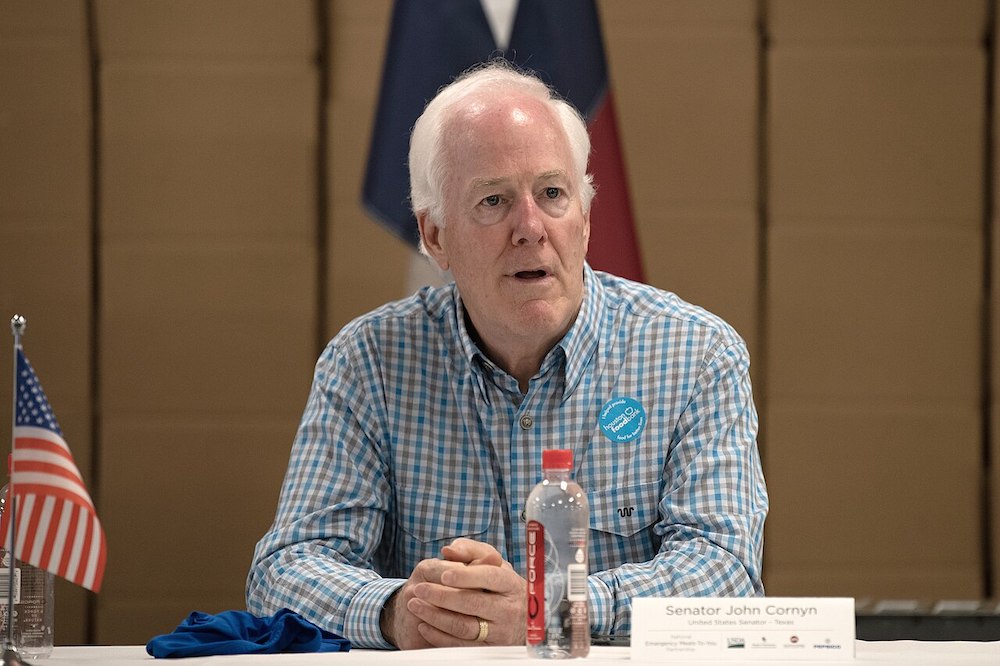
Several dark money groups tied to the same Republican operative have funneled millions of dollars into Texans for a Conservative Majority, a super PAC that spent heavily to boost U.S. Sen. John Cornyn, R-Texas, and attack his Republican rivals in the Lone Star State’s record-breaking Senate primary.
Texans for a Conservative Majority has raised nearly $35.6 million this election cycle, according to Federal Election Commission filings. At least $8.3 million — nearly a quarter of that total — came from six nonprofits that each contributed $100,000 or more and that are not required to publicly disclose their donors: Ohio Works ($5.5 million), Condorcet Initiative Corp ($1.1 million), Leon Rachel Corp ($1 million), Ardleigh Impact Corp ($250,000), America First Digital ($250,000) and Townsend Six Corp ($150,000). All six are designated 501(c)(4) “social welfare” organizations, a tax status that exempts them from federal donor disclosure requirements.
The super PAC, which can independently support or oppose candidates but not coordinate with any campaigns, has spent more than $24 million on the race: $4.9 million backing Cornyn and the remainder opposing Republican challengers Ken Paxton ($14 million) and Wesley Hunt ($5.1 million). That spending is part of a flood of money that has made the race the most expensive Senate primary on record. Through Feb. 27, the 2026 Texas Senate race had already seen more than $122 million in spending, surpassing Arizona’s 2022 record of $109.5 million, according to the media tracking firm AdImpact.
Cornyn and Paxton won the most votes in the March 3 primary and advanced to the May 26 runoff. The winner will face Democratic state Rep. James Talarico in November.
Donald Tobin, a professor of law at the University of Maryland who specializes in nonprofit taxation and campaign finance law, told OpenSecrets that voters should be “extremely concerned” about the rise of dark money in this election and in politics more generally.
“The foundational aspect of campaign finance disclosure is to provide voters with information about whom they are hearing from and whether those people have some bias or interest,” Tobin said. “You can’t make informed decisions about what’s being said to you if you don’t have an understanding of who is saying it.”
Inside the dark money network tied to Staci Goede
Three of the nonprofits funding Texans for a Conservative Majority — Condorcet Initiative Corp, Leon Rachel Corp and Ardleigh Impact Corp — listed longtime Republican operative Staci Goede as treasurer on IRS filings submitted in 2025. Ardleigh Impact Corp also listed Goede as president and secretary. Goede previously served as chief financial officer of the Republican State Leadership Committee and is currently treasurer for 26 conservative political action committees in the 2026 election cycle.
The filings also reveal that Margee Clancy, a former controller for the Republican State Leadership Committee, was listed as president and secretary of Condorcet Initiative Corp. Clancy previously held the same roles at Ardleigh Impact Corp before resigning in July 2024 and being replaced by Goede.
Ardleigh Impact, Leon Rachel and Condorcet Initiative were all formed within a two-month span in late 2023 — on Oct. 25, Dec. 7 and Dec. 18, respectively — according to official incorporation records. Although the nonprofits were all registered in Delaware, Leon Rachel and Ardleigh Impact listed the same Springfield, Virginia, address associated with Goede as their company address in 2024 IRS filings.
Politically active 501(c)(4) organizations can share officers as long as they remain legally separate and do not coordinate directly with candidates or political parties. Rather than being illegal, Tobin said, this overlap reflects a legal “structural problem at its core”: Voters looking at the groups donating to a super PAC may assume the organizations are independent when, in reality, many share some of the same political operatives while shielding their donors.
“These dark money groups relying on what Congress and the administration and the courts have done are making a mockery of the regulatory structure here,” Tobin said. “They’re not allowed to coordinate with a candidate, but they can do lots of things that fall short of what people have determined to be coordination. So it makes sense for organizations to use the same people who know how to do this work.”
The nonprofits have also funded many of the same Republican-aligned political organizations and super PACs across recent election cycles. Leon Rachel Corp and Ardleigh Impact Corp, for example, both contributed to conservative groups including Congressional Leadership Fund, Together for Nevada’s Future PAC, Maryland’s Future and Hispanic Leadership Alliance during the 2024 cycle.
Texans for a Conservative Majority is the only super PAC all three Goede-linked nonprofits have funded so far during the 2026 cycle. Condorcet Initiative Corp and Ardleigh Impact Group also each gave $1 million to Eighteen Fifty-Four Fund, a super PAC affiliated with Sen. Ted Budd (R-N.C.), accounting for $2 million of the group’s approximately $2.2 million raised.
501(c)(4) groups or 527s?
Several of the nonprofits funding Texans for a Conservative Majority reported little visible activity beyond sending millions of dollars to politically active groups and super PACs, according to IRS filings reviewed by OpenSecrets. Some reported no employees, while others listed only a single voting member.
- Townsend Six Corp, formed Dec. 12, 2024, brought in $8 million in contributions during the same month it was created. The nonprofit disclosed no program activity, no employees, $0 in expenses and $0 in salaries or other compensation in 2024.
- Condorcet Initiative Corp took in $15 million in revenue while listing no employees and no volunteers. The group described its 2024 activity as “organizational efforts only” and stated that “program service activity will begin in 2025,” even after taking in millions of dollars in contributions.
- Leon Rachel Corp disclosed $11.2 million in political campaign activity expenditures during the year ending in December 2024 despite listing no employees, no volunteers and a single voting member.
- Ohio Works reported about $7.4 million in revenue while listing no employees.
The lack of employees does not by itself indicate wrongdoing, as nonprofits can rely on contractors and outside vendors rather than full-time staff. Both Leon Rachel Corp and Ardleigh Impact Corp, for example, stated in their tax filings that “expenses also include independent contractors.” Newly formed nonprofits may also take time to build out staffing and operations.
However, Lloyd Mayer, a professor at the University of Notre Dame Law School, said nonprofits with little visible activity beyond transferring money to politically active groups could raise questions about whether they are functioning primarily as “social welfare” organizations as intended, or as so-called 527 organizations, tax-exempt groups formed primarily to influence elections and required to disclose their donors.
Federal law allows 501(c)(4) groups to engage in some political activity so long as promoting social welfare remains their primary purpose. But Mayer said regulations do not clearly define what qualifies as political activity or how much political activity is permissible. In practice, campaign finance watchdogs and tax law experts have often interpreted the standard to mean political activity cannot make up a majority of a group’s overall activities or spending, though the IRS has never formally established a specific percentage threshold.
“For a group that has no employees, has apparently no other activities, rather than passing money on to someone else, that would raise a question in my mind of ‘what else are they doing besides sending money on to the super PAC?’” Mayer said. “If all they’re doing is sending money onto the super PAC, they’re clearly not a 501(c)(4). Then they are a 527 political organization.”
How dark money groups use layered networks to shield donors
Politically active 501(c)(4) nonprofits proliferated after Congress imposed disclosure requirements on politically active 527 organizations in 2000, prompting many groups to shift toward nonprofits that are not required to publicly disclose their donors.
Though politically active nonprofit networks existed before Citizens United v. FEC, Tobin said the Supreme Court’s 2010 ruling dramatically expanded the amount of dark money flowing into politics by allowing corporations and outside groups to spend unlimited amounts independently in elections, helping fuel the rise of super PACs and politically active nonprofits that can raise and spend unlimited sums.
“Citizens United was like putting the system on steroids,” Tobin said. “Citizens United didn’t create the playbook that these organizations are using, but it increased the money that could go into the system.”
Tobin said politically active groups increasingly rely on layered networks of nonprofits, LLCs and other entities to obscure the flow of political money while still complying with federal disclosure laws.
The FEC previously investigated several groups involved in funding Honor PAC, a federally registered super PAC that spent money on Ohio’s 2018 House speaker race. According to publicly released investigative records, Ohio Works transferred $320,000 to Independence and Freedom Network, a nonprofit the FEC discovered to be controlled by Republican operatives Joel Riter and Tom Norris. Investigators found some of those funds later moved through an LLC before ultimately reaching Honor PAC, while public disclosure reports initially only listed the LLC as the contributor.
The Campaign Legal Center also filed a complaint alleging Ardleigh Impact Group was used in a “straw donor” scheme to conceal the true source of more than $2.5 million in contributions sent to six federal political committees. According to the complaint, Ardleigh contributed money to groups including the Congressional Leadership Fund, Defend Ohio Values PAC, AFC Victory Fund and Conservatives for American Excellence.
Maurice Cunningham, a retired associate professor of political science at the University of Massachusetts at Boston, said “hiding the true source of money is the profession” of some compliance operatives who help route political money through layered nonprofit networks.
“They’re good at it or they won’t last for a long time,” said Cunningham, who is also the author of the 2021 book Dark Money and the Politics of School Privatization. “The system over the years — particularly since Citizens United — has broken down bit by bit to now, where it’s almost the wild west.”
The politics protecting dark money
Since 2016, Congress has included riders in annual appropriations bills blocking the IRS from issuing new guidance clarifying what qualifies as political activity and how much political activity 501(c)(4) organizations can engage in before jeopardizing their tax-exempt status. The restrictions grew out of backlash to the 2013 “Tea Party scandal,” when Republicans accused the IRS of unfairly scrutinizing conservative nonprofits. Amid the controversy, former President Barack Obama asked acting IRS Commissioner Steven Miller to resign, and Lois Lerner, then-director of the agency’s exempt organizations division, later retired.
Cunningham said politicians are unlikely to remove the appropriations riders or pass legislation requiring 501(c)(4) organizations to disclose their donors anytime soon because elected officials in both parties benefit from the current system.
“Look who the beneficiaries of these c4s are — it’s the politicians,” Cunningham said. “You have politicians acting in their own self-interest, and I mean politicians of both parties, because both parties benefit from the extremely wealthy. The fact that politicians have basically neutered IRS enforcement tells you a whole lot about the kind of environment that we live in where billionaires play freely and the rest of us have dwindling influence.”
Though Congress only restricted the IRS from issuing new guidance — not from enforcing existing law — Mayer said the fallout from the controversy has made IRS officials reluctant to aggressively pursue politically active nonprofits.
“Everyone at the IRS knows what happened to the acting IRS commissioner because of the Tea Party scandal,” Mayer said. “Regardless of who’s sitting in the White House, IRS employees are generally going to shy away from aggressive enforcement of the limits on 501(c)(4) political campaigns, because it’s asking to attract congressional ire. The bottom line is if you’re looking for the IRS to enforce the limits on 501(c)(4) political campaigns, you’re going to be waiting a long time.”
This article was originally published by OpenSecrets, a nonpartisan, nonprofit organization that tracks money in politics. View the original article.
Sign Up for SA Current newsletters.
Follow us: Apple News | Google News | NewsBreak | Reddit | Instagram | Facebook | Twitter | Or sign up for our RSS Feed
Related Stories

The Federal Election Commission last month asked Paxton’s campaign to explain nearly $100,000 in donations that appeared to violate federal campaign law.

The Federal Election Commission’s latest letter questioning Paxton’s campaign contributions comes as he closes in on a May 26 runoff with U.S. Sen. John Cornyn.

Texas’ junior senator, who’s awful cozy with Detroit, says he wants to bring down car prices by eliminating safety features.