
An emerging super El Niño could have wide-reaching impacts, from fewer Atlantic hurricanes to wetter conditions across the southern U.S.
WASHINGTON — Weather forecasters are predicting the arrival of the weather pattern phenomenon El Niño, with an 82% chance of emergence in May through July.
According to the latest from the National Weather Service’s Climate Prediction Center, an El Niño was likely to form next month and persist through the winter in the Northern Hemisphere. Despite a strong prediction, forecasters were still uncertain about the peak strength of the weather phenomenon.
“The strongest El Niño events in the historical record are characterized by significant ocean-atmosphere coupling through the summer, and it remains to be seen whether this occurs in 2026,” weather forecasters said in a May 14 notice.
What is a super El Niño ?
A super El Niño is an especially strong phase of the El Niño–Southern Oscillation, when sea surface temperatures in the central and eastern equatorial Pacific become significantly warmer than average—typically exceeding about +2.0°C above normal.
Recent mean forecast guidance from the European Centre for Medium-Range Weather Forecasts in April suggested this event could reach around +2.5°C, with warming continuing into October 2026.
This level of warming places it firmly in “super” El Niño territory. As these ocean temperatures increase, they shift where storms form in the tropics, which in turn reshapes global atmospheric patterns. During a super El Niño, these global changes are amplified, strengthening the Pacific jet stream and redistributing heat and moisture on a global scale.
What makes this notable is that oceans and surface temperatures are already elevated compared to pre‑industrial levels (mid‑to‑late 19th century), meaning El Niño will be riding on a warmer baseline compared to previous years. Potentially amplifying its influence on the climate system.
One of the most consistent impacts is on Atlantic hurricane season. Strong El Niño conditions increase upper-level winds across the tropical Atlantic—known as wind shear—which disrupts storm development and makes it difficult for hurricanes to organize and intensify.
As a result, super El Niño years are often associated with below-average Atlantic hurricane activity. Meanwhile, the eastern Pacific tends to be more enhanced, with warmer waters and favorable conditions supporting an increase in tropical storm and hurricane development.
On Thursday, that effect was confirmed as the National Hurricane Center released its official forecast for the 2026 season. It predicted a near-to below-average season in the Atlantic, with 8 and 14 named storms expected.
Forecasters say developing El Niño conditions during the peak of hurricane season are a major reason activity could remain below average. El Niño tends to increase upper-level winds across the Atlantic, making it harder for tropical systems to organize and strengthen.
At the same time, NOAA says the Eastern Pacific is expected to see above-average activity because El Niño has the opposite effect there.
Despite the lower outlook, meteorologists continue emphasizing that it only takes one storm to make a major impact.
Super El Niño might mean more rainfall
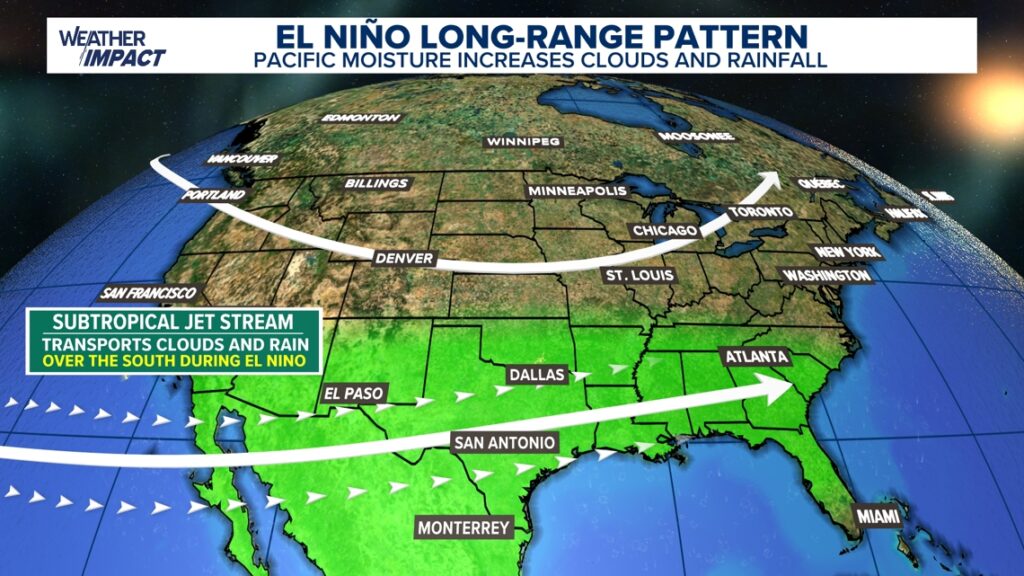
Across the United States, a super El Niño significantly influences seasonal rainfall, especially during winter. The stronger, more active jet stream typically shifts south, bringing wetter-than-average conditions to the southern U.S., including California, the Gulf Coast, and the Mid-South.
This pattern can be especially beneficial for drought-stricken areas across the South, where repeated storm systems help replenish soil moisture, improve river and reservoir levels, and support agriculture heading into the next growing season. In contrast, the northern tier—such as the Pacific Northwest and parts of the Midwest—often sees drier and sometimes warmer conditions.
While the increased rainfall in the South can raise concerns about flooding, it also provides a meaningful opportunity for drought relief.
When scientists speak about historic strong El Niño events, they often reference these years, 1982‑83, 1997‑98, and 2015‑16 as benchmarks for comparison. There is growing discussion among forecasters that this could rival those historic events in magnitude — and, if the anomaly really does reach that level, it would be among the strongest in recorded history.
However, forecasters caution that these outlooks made this far in advance have uncertainty, and the exact peak strength won’t be known until later this year.