
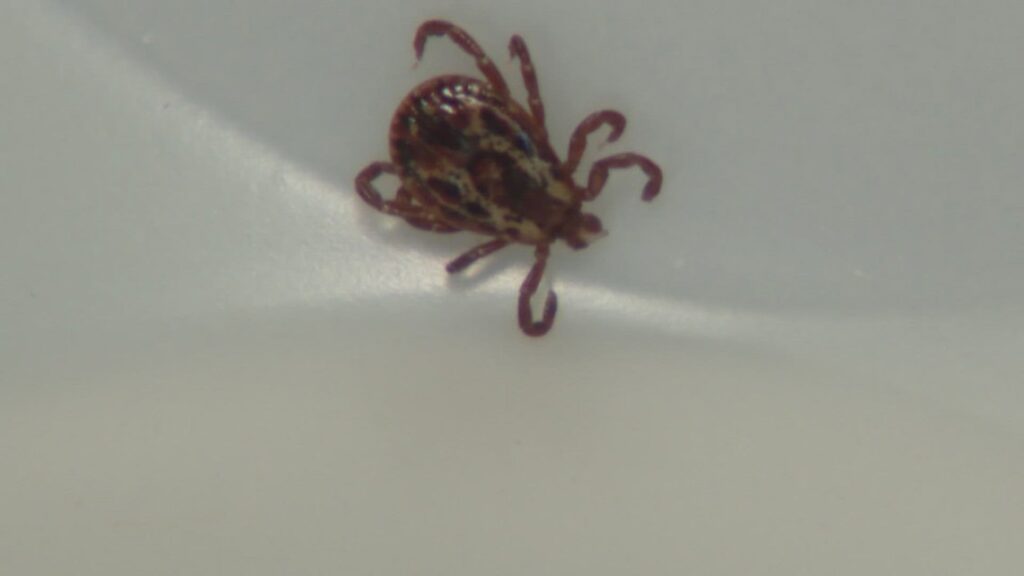
Emergency room visits for tick bites are at their highest weekly rates in nearly a decade — and doctors say prevention is your best defense.
CLEVELAND — Tick season is in full swing, and this year the numbers are hard to ignore. Emergency room visits for tick bites are currently at their highest weekly rates since 2017, according to new data from the Centers for Disease Control and Prevention. Every year, an estimated 31 million people in the United States are bitten by a tick. Doctors say far too many people are still underestimating the risk.
“I just don’t know that we take tick bites and tick bite prevention as seriously as I would like to see it. It really is important,” Dr. Jennifer Caudle, a family physician and associate professor at Rowan University, said.
Why ticks are a real health threat
Ticks carry bacteria, viruses, and parasites that cause a wide range of illnesses. Lyme disease is the most common, with an estimated 476,000 patients treated for Lyme disease each year in the United States. But Lyme is far from the only concern. Ticks also spread ehrlichiosis, anaplasmosis, Rocky Mountain spotted fever, and other serious conditions.
Lyme disease, in particular, can be tricky to catch early. Symptoms are often vague at first — joint pain, fatigue, flu-like symptoms — and the telltale bull’s-eye rash doesn’t always appear.
“The symptoms of Lyme disease often overlap the symptoms of other conditions. Often, the symptoms can start out very vague, whether it’s just joint pains or fatigue. There is a characteristic bull’s eye rash, but we don’t always see that,” Caudle said. That overlap with other conditions makes a clinical diagnosis a challenge, even for experienced physicians.
How to prevent a tick bite
The best protection is avoiding a bite in the first place. When heading into wooded, grassy, or brushy areas, doctors recommend:
- Stay in the center of trails to reduce contact with vegetation where ticks wait
- Wear long sleeves, long pants, and a hat
- Use an Environmental Protection Agency-approved insect repellent — a full list is available at epa.gov
- Treat clothing and gear with products containing 0.5% permethrin, which continues to repel ticks even after washing
- If using both sunscreen and repellent, apply sunscreen first, then the repellent on top
When you come back inside, shower right away. Dry your clothes on high heat, which kills any ticks that may have hitchhiked home with you. And don’t forget your pets — dogs and cats that spend time outdoors can carry ticks inside, where they may then attach to household members.
Do a full-body tick check
After any time outdoors, check your entire body — including the hairline, behind the ears, armpits, groin, and behind the knees. “We need to be checking ourselves and check each other in the hair and the crevices — places where ticks may like to hide,” Dr. Caudle said.
Check your kids and check each other. Ticks are small and often painless, so a thorough visual check is important. Removing an attached tick within 24 hours can help prevent Lyme disease.
How to remove a tick
If you find an attached tick, don’t panic — but do act quickly. Use fine-tipped tweezers or your fingers to grasp the tick as close to the skin’s surface as possible. Pull upward with steady, firm pressure. Don’t twist or jerk, which can cause the tick’s mouthparts to break off in the skin. Once removed, dispose of the tick properly.
“Depending on how long that tick has been attached, where in the country you live, what symptoms you may or may not be having, we may need to do something further,” Caudle said.
Then call your doctor. Depending on how long the tick was attached, where you live, and whether you develop any symptoms, your physician may recommend additional steps.
Know the warning signs
If you develop a rash or fever in the days to weeks after a tick bite — or after spending time in an area where ticks are common — seek medical care promptly. Don’t wait to see if symptoms get better on their own.
The bottom line: tick bites are preventable, and the steps to protect yourself are simple. Check your repellent, check your clothes, and check your body — every time you head outdoors.