
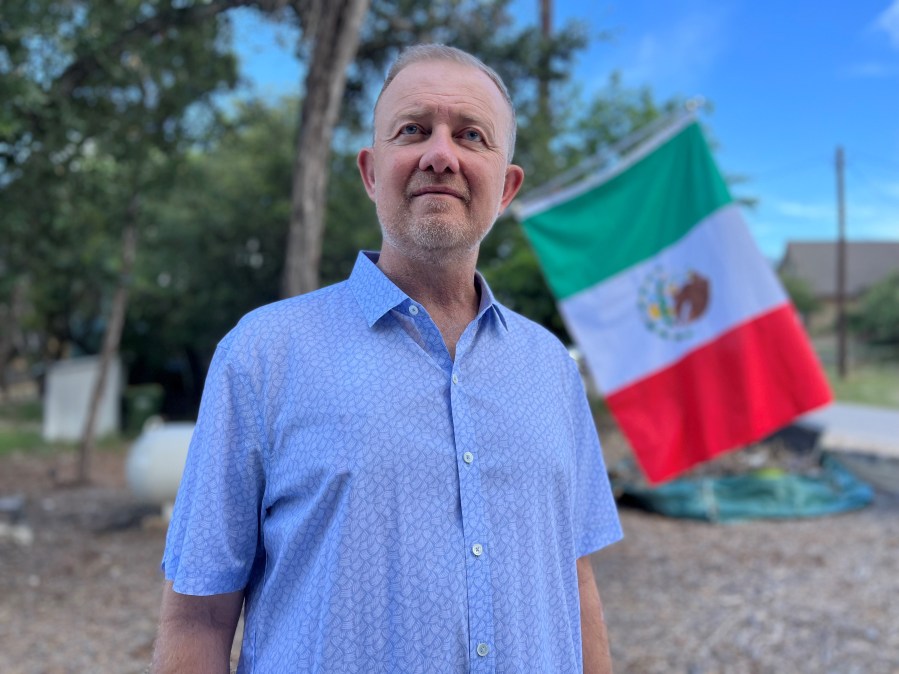
AUSTIN (KXAN) – Dan Weber and his husband, from Dripping Springs, wrote a letter to their senator as a last resort in May. The couple said they have been trying since 2022 to sponsor 25-year-old Mexican citizen Angel to study at the University of Texas at Austin’s English Language Center. Emails between Weber’s husband and UT Austin staff reveal how, year after year, Angel deferred his admission to later semesters because he was unable to secure a student visa.
“This recent spring was the fourth time we tried,” Weber said.
The couple’s motivation to help Angel stems from a desire to pay it forward. According to Weber, Angel came to the US under humanitarian parole years earlier to see if he was a match for Weber, who was in kidney failure.
He wasn’t – but Weber said he still wanted to do something nice for someone who tried to do something nice for them.
In his letter to U.S. Sen. John Cornyn, R-Texas, Weber’s husband, Clement, wrote, “Our concern is that having been turned down for an F-1 visa before, he will face similar problems in this application.” He wrote about Angel’s goals to improve his English and pursue a career as a commercial pilot.
Over the years, the visa interviews have been quick, according to Weber. The shortest was under 10 minutes. The most recent under the Trump administration was the longest, but the consular post still denied Angel’s visa.
The spokesperson for U.S. Rep. Lloyd Doggett, D-Texas, stated that their office has reviewed more than 124 visa cases since January, with 40 of those cases remaining pending.
A spokesperson for Doggett stated that in all the cases they have seen, there are long delays in communication and unanswered phone calls, including in instances where families are obtaining visitor visa interviews at embassies to return to the U.S.
Since January, when President Donald Trump took office, the U.S. State Department temporarily halted scheduling new visa appointments (the State Department has since lifted the pause), suspended issuing visas to individuals in 19 countries, and implemented a new policy to vet the social media profiles of foreign nationals seeking a U.S. visa. Applicants will now have to make their social media profiles public.
Last spring, the federal government also faced a slew of legal challenges after the State Department abruptly terminated approximately 4,700 international students from the Student Exchange Visitor Information System, or SEVIS. The database tracks the minute-to-minute status of international students and workers in the U.S.
For its part — the State Department said consular posts “constantly adjust their schedules to allow for sufficient time to fully vet the cases before them” and told KXAN, “in every case, [it] will take the time necessary to ensure an applicant does not pose a safety risk to the safety and security of the United States.”
Waiting to see how student visas affect universities
Matthew Hughes is a former consular officer, and through his legal practice, BorderCall, he represented Angel in trying to obtain a student visa. Hughes said that while some challenges with visa applications have always existed, it is becoming increasingly difficult to get a visa in the United States.
Hughes said that it can have a ripple effect on college campuses.
“I imagine that they are dealing with a lot of phone calls. They are probably dealing with a lot of withdrawn applications. And I think, too, assuming that fewer people show up on these college campuses in the fall, that takes a way a bit from this, from the student experience, right?” Hughes said.
With less than two weeks before the start of the Fall 2025 semester, University of Texas at Austin officials say they still don’t have a clear picture of the impact, if any, that new federal visa policies and the SEVIS terminations last spring might have on its international student population.
University officials said they won’t officially know how many international students will enroll until the official census is recorded on the 12th day of classes this semester.
According to UT Austin data, from January to July 31, the university issued 1,220 I-20 forms to new prospective international students. In the same period in 2024, the university issued 1,322. Individual universities issue the I-20 forms, which visa applicants use to demonstrate their authorization to study at a specific institution.
UT Austin’s Texas Global officials say I-20 issuance data is an unreliable indicator of the international student body in any given year. According to Texas Global, international students admitted to multiple schools might receive an I-20 form from each institution.
Texas Global told KXAN that even if the university issues fewer I-20s in one year compared to the previous year, the number of students who ultimately enroll may remain constant. At UT Austin, students can arrive and enroll until the census date.
Officials with Texas Global also noted that, from year to year, there are variations in student behavior, such as the level of commitment among applicants to attend, as well as changes in a country or region’s economic situation, which can impact the I-20 issuance rate.
After repeated failed attempts, Dan Weber said they are embracing the idea that Angel might never be able to get a student visa. They are now thinking of ways they can be helpful to him abroad.
“We are kind of like ‘why can’t we make this happen for you?’” Weber said. “We are taking a lesson from him. He has never been like – ‘Oh, woe is me.’ He’s always been ‘This is what I have. Let me make the best of it.’ So, we are saying — OK, maybe the best of it for you isn’t in the United States.”
Investigative Photojournalist Chris Nelson contributed to this report.