
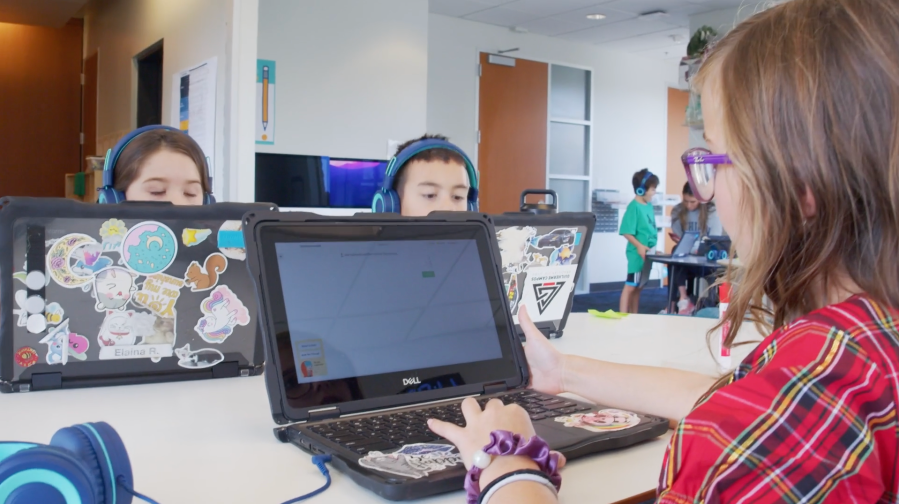
AUSTIN (KXAN) — Just a year ago, many Texas school districts were warning teachers and students not to use tools like ChatGPT for school. Now, those same tools are starting to be built into lesson plans.
Across the state, and in Central Texas, schools are beginning to explore how artificial intelligence can be used to support learning, personalize instruction and prepare students for a tech-driven future. Some districts are piloting AI tools in classrooms, while others are offering professional development for teachers or even developing curriculum around AI literacy.
The shift comes as education leaders weigh both the opportunities and risks of bringing AI into K–12 environments.
“AI is going to be almost in every industry moving forward,” said Dr. Hafedh Azaiez, superintendent of Round Rock ISD. “So we definitely want our students to have access to AI and also use AI because we believe that will really set them apart.”
Azaiez said his district is working on building policy around responsible and ethical AI use. “We’re not the district that we’re going to say, ‘No AI.’ It’s just we need to figure out the policy around it and how to use it within the legal framework, if you will, and ethical framework.”
The early bans were driven by fears of cheating, misinformation and the unknowns surrounding these emerging tools. But as AI becomes more mainstream, and as more industries adopt it, educators say they have to rethink their approach.
The Texas Education Agency is using AI to score written answers on the STAAR test, while districts are exploring tools like PowerBuddy and MagicSchool AI to build lessons. Some private schools, like Alpha School in Austin, are even using AI to personalize learning for each student.
Personalized Learning Powered by AI
“We can’t do the same thing that we’ve done for 50 or 100 years,” said Gaston Griffin with Studient, which uses an AI platform to create personalized learning paths. “Kids can jump onto TikTok and scroll through, and I guarantee you that algorithm is going to personalize what they’re seeing. So why shouldn’t our education personalize what they need?”
Griffin, a former educator and parent, has seen firsthand how Studient’s AI platform supports individualized learning and gives teachers more time to engage with students.
“AI can really help in that area where we are personalizing students’ learning so that teachers can get back to doing what they, you know, love: engaging with students and building rapport,” he said.
That mission is shared by other tools designed specifically for educators. One example used in Texas is MagicSchool.ai, which helps teachers streamline lesson planning, create rubrics and draft emails. The goal is to automate routine tasks to give instructors more time to teach. According to MagicSchool AI’s website, they have partnered with over 13,000 schools worldwide, including local districts like Lake Travis ISD.
“There’s always a human in the loop,” Griffin said.
In Studient’s model, students take diagnostic assessments to identify learning gaps, like missing foundational skills in math or reading. From there, AI lays out a personalized learning sequence, tracks engagement and identidies when a student may need extra support. 2-Hour Learning has partnered with at least six local campuses including Georgetown, Austin and Bastrop.
“Mastery-based learning means 90% or higher,” Griffin said. “There has to be a true investment of time and energy. We are not skipping over that. This actually is a great way to build resilience and grit.”

Caution and Capacity: What It Takes to Make AI Work in Schools
Some educators stress that while AI has potential, it must be implemented carefully.
“There’s a lot of noise around AI,” said Marcela Andrés, an education consultant and former classroom teacher. “To be very clear, teachers cannot be replaced by technology. An educator inspires hope, inspires joy of learning and creativity. AI cannot do that, no matter how many prompts you give it.”
Andrés says successful implementation depends on buy-in, not just from teachers, but also from families and communities.
“One teacher may fully embrace the tool, another teacher may be only using it 10% and that in itself is problematic,” she said.
Not all districts have made the leap. Some administrators remain cautious, citing a lack of state-level guidance on data privacy, equity and appropriate use.
“We want to make sure that we use AI first to help our teachers with their workload and also give them the tools they need so they can enhance what they’re doing with our students,” Azaiez said.
For now, the role of AI in Texas classrooms is still being defined, with early pioneers leading the way, and the conversation is shifting. The question is no longer if it belongs in schools; it’s how it will be used. And while it’s far from standard practice, the groundwork is already being laid.