
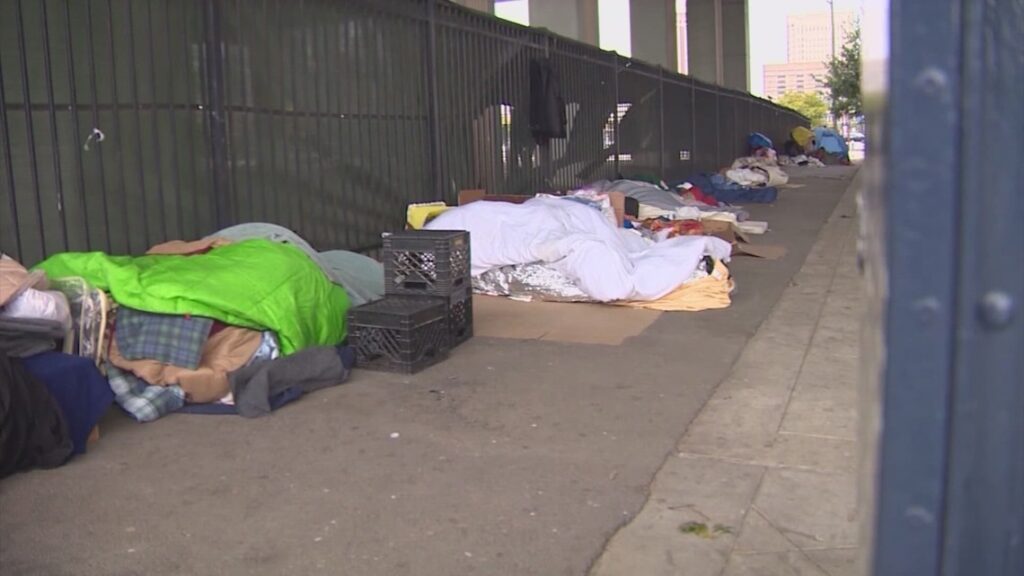
City leaders want to get homeless people off the streets and connect them with resources.
HOUSTON — As Mayor John Whitmire’s administration aims to accelerate efforts to address homelessness in Houston, City Council will soon consider whether or not to add a revision of the city’s civility ordinance to that plan.
On Wednesday, Housing and Community Development Director Mike Nichols and Public Safety and Homeland Security Director Larry Satterwhite presented to City Council a report on the administration’s progress so far in being able to move homeless people off city streets and connect them with resources as well as why they believe expanding the civility ordinance can help.
“Homelessness, as all of you know, is a complex issue that requires multiple tools to help people move off the street,” Nichols said.
Whitmire hopes ramping up efforts can better link those without a home to pathways that could lead to more permanent housing situations.
“If you get folks in a treatment facility, housing, mental health services, about half of them, if you give them a caseworker, we can solve their problem,” Whitmire said.
Currently, the city’s civility ordinance is a targeted approach where residents of a neighborhood have to collect signatures, bring those before City Council, and have the body approve it in order for the ordinance to apply to their part of the city. There are a dozen neighborhoods that have the ordinance, which prohibits people from lying down, sitting or placing personal possessions on city sidewalks from 7 a.m. to 11 p.m.
The proposed expansion of the ordinance would make that prohibition 24 hours a day, though for now, officials only want that revision for two neighborhoods: the Central Business District and East Downtown.
“Reason being is that we, right now, do not have enough resources and we don’t have enough beds to go anywhere beyond that,” Satterwhite said.
Along with limited bed space and barriers to those facilities, council members expressed concern about the potential criminalization of homelessness, as a citation for a violation of the ordinance would be a Class C misdemeanor with a maximum fine of $500, according to Satterwhite.
“When we talk about records and creating that record and outstanding warrants in those increased interactions with public safety, there is that potential,” District C Council Member Abbie Kamin said.
Officials acknowledged citation violations could lead to warrants being issued, but said the aim is not to remove people and place them in jail, but rather find ways to have them agree to be connected to services.
“This is a tool to help people do their jobs an,d I really think we have to see it that way,” Nichols said. “And the end result is not going to be criminalized, except for a very small percentage.”
District I Council Member Joaquin Martinez said he was supportive of the initiative, but wants future housing and shelter options to be more spread out throughout Houston.
“It’s always been going to the East End,” Martinez said of low-barrier shelters in the city. “I think it’s important that we identify these locations strategically across the city.”
Whitmire administration officials told KHOU 11 the proposed ordinance is set to go before City Council for a vote in the next week or two.