
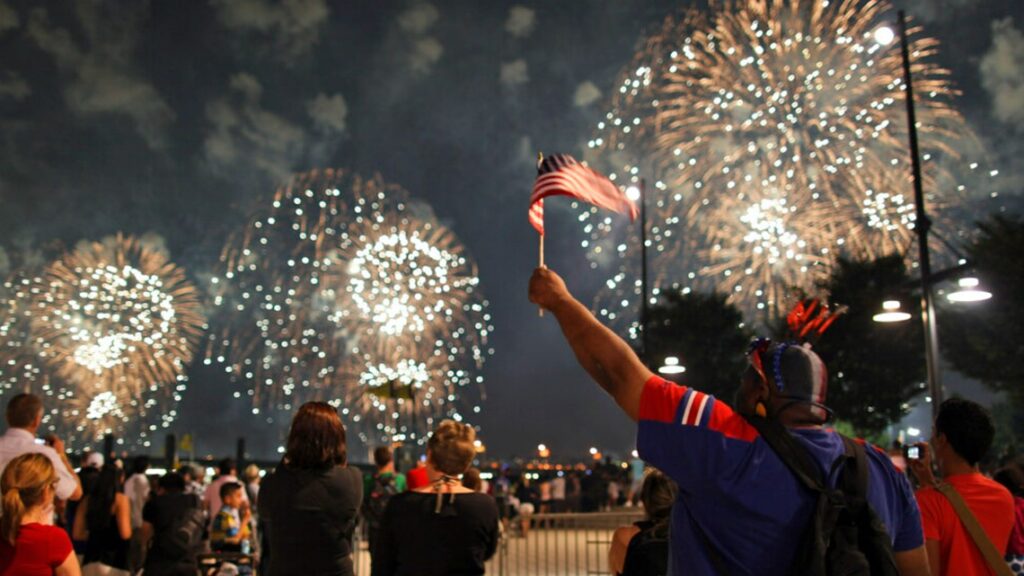
Independence Day, observed every year on July 4, often involves cookouts, patriotic parades, elaborate firework displays and other red, white and blue festivities.
WASHINGTON — Millions across America will be decked out in red, white and blue Friday to celebrate the Fourth of July.
Independence Day, observed every year on July 4, often involves cookouts, patriotic parades, elaborate firework displays and other red, white and blue themed festivities.
July 4 commemorates the adoption of the Declaration of Independence, and this year is the 249th anniversary.
Here’s how the holiday evolved into the widespread celebration it is now.
Why is the Fourth of July celebrated?
On July 4, 1776, the Second Continental Congress unanimously adopted the Declaration of Independence to announce the colonies’ separation from the Kingdom of Great Britain, according to the Library of Congress.
The actual vote for independence happened two days earlier, History.com says, but July 4 is seen as the “birthday” of American independence. It’s not entirely clear why Thomas Jefferson pushed so hard for the fourth to be the official day of America’s independence, since John Adams said July 2 “will be celebrated, by succeeding Generations, as the great anniversary Festival” and that the celebration should include “Pomp and Parade…Games, Sports, Guns, Bells, Bonfires and Illuminations from one End of this Continent to the other.”
History.com says Adams would “reportedly turn down invitations to appear at July 4th events in protest” of the celebrations not being held on July 2.
Independence Day celebrations grow
On the first anniversary of the Declaration’s adoption, John Adams wrote to his daughter describing last-minute festivities in Philadelphia.
“Yesterday, being the anniversary of American Independence, was celebrated here with a festivity and ceremony becoming the occasion… The thought of taking any notice of this day, was not conceived, until the second of this month, and it was not mentioned until the third.”
Despite its last-minute nature, Adams remarked on the “brilliancy and splendour” of Philadelphia’s first Fourth of July celebration.
It’s hard to imagine a time before Americans celebrated on the Fourth of July. However, according to the Library of Congress, the celebrations didn’t become widespread until after the War of 1812. Celebrations kept growing, becoming what the Library called “the most important secular holiday on the calendar” by the 1870s — a time when even “far-flung communities on the western frontier managed to congregate.”
Massachusetts was the first state to make July 4th an official state holiday in 1781, according to History.com. Congress passed a law making Independence Day a federal holiday June 28, 1870, according to the Library of Congress.
Who wrote the Star-Spangled Banner?
Francis Scott Key, a prominent attorney, turned a wartime experience in the early 19th century into the poem that became the national anthem of the United States.
In September 1814, two years after the War of 1812 had started between the United States and the British, he was on a ship to negotiate an American prisoner’s release and witnessed a 25-hour British bombardment of Fort McHenry.
From his vantage point on the Patapsco River, then 35-year-old Key was able to see the American flag stayed up through the hours of darkness and was still at the top of the fort when the morning came. He turned it into a poem.
“And the rocket’s red glare, the bomb bursting in air, gave proof through the night that our flag was still there,” as one of Key’s original lines says. The rockets and bombs later became plural.
Initially known as “Defence of Fort M’Henry,” it was set to the music of a British song and became known as “The Star-Spangled Banner.” Over the 19th century, it became increasingly popular as a patriotic song. In March 1931, then-President Herbert Hoover officially made it the country’s national anthem.
How many white stripes are on the American flag?
The American flag holds seven red and six white horizontal stripes, a total of 13 to represent the original 13 colonies.
The crimson color represents hardiness and value while the white symbolizes purity and innocence, PBS reports.
The blue in the top left corner represents vigilance, perseverance and justice, topped by 50 stars to represent each state in the country.
Is the Fourth of July a federal holiday?
Yes — one of the first! In 1870, Congress passed an act establishing Independence Day, New Year’s Day, Christmas Day and Thanksgiving Day as holidays in the District of Columbia. According to the Congressional Research Service, these were the first four congressionally designated federal holidays.
Other than the original four, the U.S. government has designated federal holidays for Martin Luther King, Jr.’s birthday, George Washington’s birthday, Memorial Day, Juneteenth, Labor Day, Columbus Day and Veterans’ Day. In total, there are currently 11 federal holidays plus Inauguration Day which is a day off for federal employees while the new president of the United States is sworn into office.